Photos without Apple Photos

I’m looking to migrate my photo collection out of the Photos app + iCloud photo library. I fell into this setup over time since it was the path of least resistance, but I’m frustrated by bugs and limitations of the Photos app, and I don’t want to pay for expensive cloud storage that I don’t really need.

I’d love to hear what photo workflows others are using and are happy with. How do you bring in photos from both a phone and a dedicated camera? Has anyone tried the newer photo apps I’ve seen around, Iris or Aphera? How about something that works on Linux too, like Darktable?

2 Likes

The convenience factor of Photos and the iPhone has kept me, and the utilitarian view of iPhone photography I hold meant I wasn’t troubled by Photos limited features. Though syncing is definitely less than stellar, it can be very slow.

My main photography, ie with cameras, is all in sessions managed by Capture One, a pricey app for professional use. The features are stellar, extraordinary really but as I said, expensive. Still settling on a workflow for film photography, best approach for scanning, assigning useful metadata and editing. A few interesting solutions on that front out there.

2 Likes

I sympathize…

You don’t need to sync your Photos library with cloud storage. I don’t use it at all. My photos all live within a library on my Mac’s SSD.

If your library gets too large (which might be the case for you, if you’re seeing slowdowns and crashes), you can make multiple separate libraries.

Apple’s Image Capture app will let you offload photos from a phone.

For dedicated cameras, I always remove the SD card from the camera and stick it in a USB reader. I can then open the card in the Finder and drag/drop the images wherever I want to put them.

I can also import them directly from the SD card into Photos - it will recognize a storage device with a “DCIM” folder as a photo source.

I haven’t bothered with proprietary USB camera cables for a very long time.

4 Likes

I’ll preface this post to say in a previous life I was a press photographer, and the vast bulk of what I shoot today is still with traditional cameras rather than phones. For years I used Capture One but I swapped to Lightroom Classic as C1 was getting a little too expensive (and I still wanted Photoshop). Despite my pronounced hatred of subscriptions, the Adobe Photo bundle is fairly reasonable.

There are many, many other options depending on what you need. Do you need RAW processing, cataloging, basic editing, complex editing, compositing, AI masks, accurate colour fidelity, printing etc. All these will influence the direction you choose.

Affinity is a decent Photoshop alternative and there are many other cheap offerings which vary greatly in functionality and quality. Take a look here for a video overview of some of them.

If you want a free organiser (DAM), maybe consider Adobe Bridge. I’ve not really used it but I know people who do, and find it useful. You could look at Photomator/Pixelmator but they’re now owned by Apple so you’re unlikely to cut the umbilical to iCloud.

There’s things like Nitro (written by one of the original Aperture developers) but I found its early iterations underwhelming. Cyme make Peakto, a nice AI driven catalog app, but it’s expensive and lacks editing capabilities.

Lightroom is very capable but has enough quirks to have me swearing at it often. It gets regular updates but suffers a bit of bloat - performance on large catalogs can be ordinary. I really miss Aperture, at the time it seemed light years ahead of the field.

As for Darktable, it’s nirvana for masochists — like punching yourself in the face, then asking someone else to join in. Life’s too short to be this frustrated.

2 Likes

Perhaps something like Immich is what you’re looking for?

I’m happy with iCloud Photo for now so I haven’t used it but it looks interesting enough that I’ve saved it for future reference.

My workflow is to keep my system Apple Photo library to a modest size (around 20GB) and to:

a) Move older iPhone photos to an additional library. PowerPhotos is the best app for managing multiple Apple Photos libraries.

b) Export from Apple Photos using osxphotos (command line app) and then import into Lightroom Classic. osxphotos makes it possible to put Apple Photos metadata into the EXIF metadata of exported images and hence into Lightroom catalog. My Lightroom library also has scanned family photos, and Canon RAWs.

c) Synchronise my LR catalog (and most photos) between my desktop iMac and MacBookPro.

But I am considering doing the opposite and exporting all my Lightroom photos and images into Apple Photos libraries. I would then use Photos and PowerPhotos as the DAM and, where needed, external editors (mostly Affinity and Photomator). Driver for this is cost of Adobe photography plan (LR+PS).

1 Like

Immich is an option if you want to take on running your own server, or you want to host it on someone else’s server - which takes you back to being reliant on a ‘cloud’, and paying for it. It’s editing tools might also be described as basic.

If that was the route someone wanted to follow, they may as well get a Synology NAS and use the included Photo management tools, although its editing is even more basic, but it does provide a decent way to share photos on the web.

I commend your bravery in wishing to do this, it could be a huge undertaking depending on several factors. I’d suggest research thoroughly, backup, and have a couple of plans, take lots of notes. Clarifying your goals will help too, as there are so many options.

Maybe try new software on a limited batch of copied image files before commiting to one.

Take some time to look big picture, like what you do with your photos, how much time you have to put in to it and so on.

I started shooting film as a child around 1968, shot for school papers and yearbooks and professionally at newspapers a couple of years. Moved into digital early ‘00s as a hobby. I’ve been through several apps over the decades as my use of photography has evolved. I liked Aperture a lot despite some drawbacks and when it was abandoned by Apple I developed my current, ah, ‘system’ :wink: .

Someday I want to digitize my physical collections but as I’ve seen what happens with software development/business plans over the decades I am trying to get as platform-independent as possible. Plus, my archiving and sharing needs are minimal.

What I’ve done is switch to a Finder-based organization and naming scheme, then use apps that can work the photos without copying/importing them. This way the photos are not hogging space or locked into any software other than basic computing, and I can relatively easily switch organizing software.

I import photos into this file structure on the Mac from iPhone with a USB cable and digital cameras’ storage cards via card adapters, til now with Image Capture, into ‘staging’ folders and when I have time I look at them and rename and delete and organize them further. Inspired by a TBT Topic, I’m more and more using GraphicConverter 12 to rename and maybe also import, as it has some nicely time-saving renaming features.

Lately I’m not manipulating the photos much, often in Photos first on iPhone, send them off as needed but mostly I snap for recordkeeping/documentation so organizing is more important than manipulation tools.

I don’t use anything Adobe or “AI”. Been using Nitro to view and manipulate, will look more at GraphicConverter for same, and I also got Acorn at some point but have barely scratched its surface.

Embarking on a home computing evolution which will hopefully result in these photo folders being available locally only on home network and manipulable from Apple and Linux devices. My first attempt I didn’t follow my own advice and it went scarily and time consumingly astray. Luckily I had backups and sufficient internet and TBT support to recover.

I see an advantage in keeping originals in one place and referencing them with other apps.

Hope something in all that is helpful.

My frustration for what Apple’s Photos app does not do forced me to move/sync all my photos to Google Photos. Not only can I search for specific photos like I could never do before, but it organizes the photos and arranges them so much better.

I also have the ability (on the iPhone) to do an A.I. enhancement/color correction on old family slides that totally gets rid of the green or red tint that happens with old color film. I am amazed how good this feature is and how well it works. The photos now look like they were taken yesterday!!

A big thumbs up for Google Photos! :+1:t2:

Thanks to everyone who’s shared their thoughts so far; all interesting! I’d definitely like to keep the originals organized as plain files, not tied up in a proprietary database organization. I’ve also looked into osxphotos a bit to export my current library, but haven’t given it a full test yet.

More workflow examples still appreciated :slightly_smiling_face:

I was in the graphics business for much of my career so I’ve seen a fair portion of the editors and DAMs. Anything from bespoke databases to Canto Cumulus to many of the recent apps mentioned above.

The simpler you can make things for yourself, the better. You can get seduced by extraordinary hierarchical keywording, multi-user editing and other such frippery (:smiley:) and forget that you are not managing a massive multi-national image database.
I’ve settled on using Photos & iCloud for day to day things like the pictures of plumbing fixtures to take-in to Home Depot (but sometimes there are good’uns in the day to day, too!) and then Capture One for the art stuff—it is a fantastic image editor. To the despair of the Capture One types, I don’t subscribe but made a one-time purchase because, frankly, I’m not producing much these days so Capture One 23 is working just fine thank you very much. Maybe I’ll have to update in a few years when they offer some magical thing but I can wait. I’m an organized person so I don’t have any trouble navigating between Photos and Capture One.

I should mention Mylio. I used it for 5 years or so in order to support several clients. Its image-editing is around Photos-level but its DAM system is first-rate. It runs on IOS, iPadOS, MacOS, Windows, and Android. Its interface is very elegant and the behind the scenes is very elegant. You can use their cloud service but they also make it ridiculously easy for you to have multiple local storage archives that are kept in-sync without any internet to and fro. It can handle huge image libraries—some of their clients are working with million-photo DBs (Yes, they do sneaky things so you can view a fair portion of that data on your iPhone). I no longer use it because I’m retired. I would like to because it’s so well done but this year they moved to a subscription model that amounts to $240/yr which for some people is a true deal but for my retired self is not. It’s worth your while to take a careful look at their website. They have a very interesting take on how to manage the volume of images now produced by the average family.

Dave

2 Likes

Nitro is getting better all the time. It can use both the Finder’s folders for photos and the Photos Library, allowing you to try it out without exporting everything from Photos first. It is also available with a lifetime license, as well as a subscription.

1 Like

Both NeoFinder and Nitro are powerful photo library organizer/managers that are Apple-native.

Nitro includes powerful photo editing. https://www.gentlemencoders.com

NeoFinder manages many types of media (CDs, books, video, etc) and includes features specific to photo library organizing, but not editing. NeoFinder – Photo Organizer

Metadata embedding (keywords, rating, persons, places) may be an important differentiator. NeoFinder’s “IPTC (XMP) Editor” embeds all metadata in the photo itself, which facilitates sharing with other photo software. Nitro stores metadata by creating for each photo a corresponding XMP Sidecar file in an Adobe standard format compatible with Adobe Lightroom, but probably not recognized by Apple Photos and other non-pro oriented apps.

1 Like

NeoFinder is now 31 years old and it shows in its completeness and sturdiness. Its focus is slightly different from something like Lightroom, it excels at doing things like cataloging all those CDs and hard drives that you have scattered about the office. It really carries on the iView MediaPro tradition and if you are awash in once-organized but now piles of I-don’t-know it’s well worth the $40.

I just used it a couple months ago when I was confronted with 5,000 some-odd email attachments to be filtered: photos, screenshots, videos, etc. Didn’t want to put them in Photos or Capture One; didn’t want to laboriously scroll through Finder previews. Aimed NeoFinder at them and a few minutes later the task was an absolute doddle.

Dave

1 Like

Thanks for taking me back in the time machine to iView Media Pro. That was a wonderful program that got me hooked on cataloguing and managing photo metadata not bound by Apple/iPhoto constraints. I stuck with it through several name changes then transitioned to Lightroom.. Only use Apple photos when using iPhone camera, then quickly airdrop to external drive and Lightroom.

On the Nitro Manual page, there are references to some interaction:

Nitro can work with both the Apple Photo Library and files stored in the File System (the Files.app on iOS and the Finder on macOS). When using the Photo Library, any changes you make using Nitro will be stored directly into your photo library

but there are also some references to limitations set by Apple against 3rd party interactions with Photos. The description is a bit over my head with technical references but there is some interaction including iCloud.

I only use Nitro with photos in Finder and almost never use Photos or iCloud so can’t speak to how that works in practice, but it does sort of sound like that is what Mr. Bhatt is aiming for.

Thanks for the pointer to NeoFinder, I took a quick look and want to explore it more later.

Can you explain what the limitations that you face are? I am using Apple Photos /iCloud Photos on all my devices and on my iMac, I have a large SSD-disk attached that collects all photos (settings download all to this computer) I have around 140.000 photos and am using almost 3 TB, which sync fairly well across the board. I shoot raw, btw. and have a number of generations of both scanned and earlier digital photos in the collection. I have no performance issues at all, and I am able to search all my photos from about 1920 to now in one go.

For editing I use Luminar Neo and ON1, and sometimes Pixelmator Pro and even Photos own editing suite, that seems targeted at jpeg’s or HEIC’s, all depending on the task, and everything gets stored in iCloud Photos.

I have also been pondering if I should get off iCloud and just use my iMac as photo server with immich or similar, but I have not found any app suite, that covers both IOS and macOS to a degree that I would be happy to use it. Google Photos would probably be my last choice, btw. Do they still limit the size of uploads? I have a friend who believed in Google and had most of his raw collection obliterated, as Google just changed the format on upload when the photos were more than 20MB large. I also do not trust their privacy policies.

But I am genuinely interested how to handle a large collection without the Apple tools, that I don’t think I could live without.

So many times I find myself wishing we still had iView Media Pro

Nitro includes powerful photo editing. https://www.gentlemencoders.com

NeoFinder manages many types of media (CDs, books, video, etc) and includes features specific to photo library organizing, but not editing. NeoFinder – Photo Organizer

Thanks so much for these suggestions. I’ve been looking for a photo organizer I could point at years’ worth of email attachments to find all the photos.

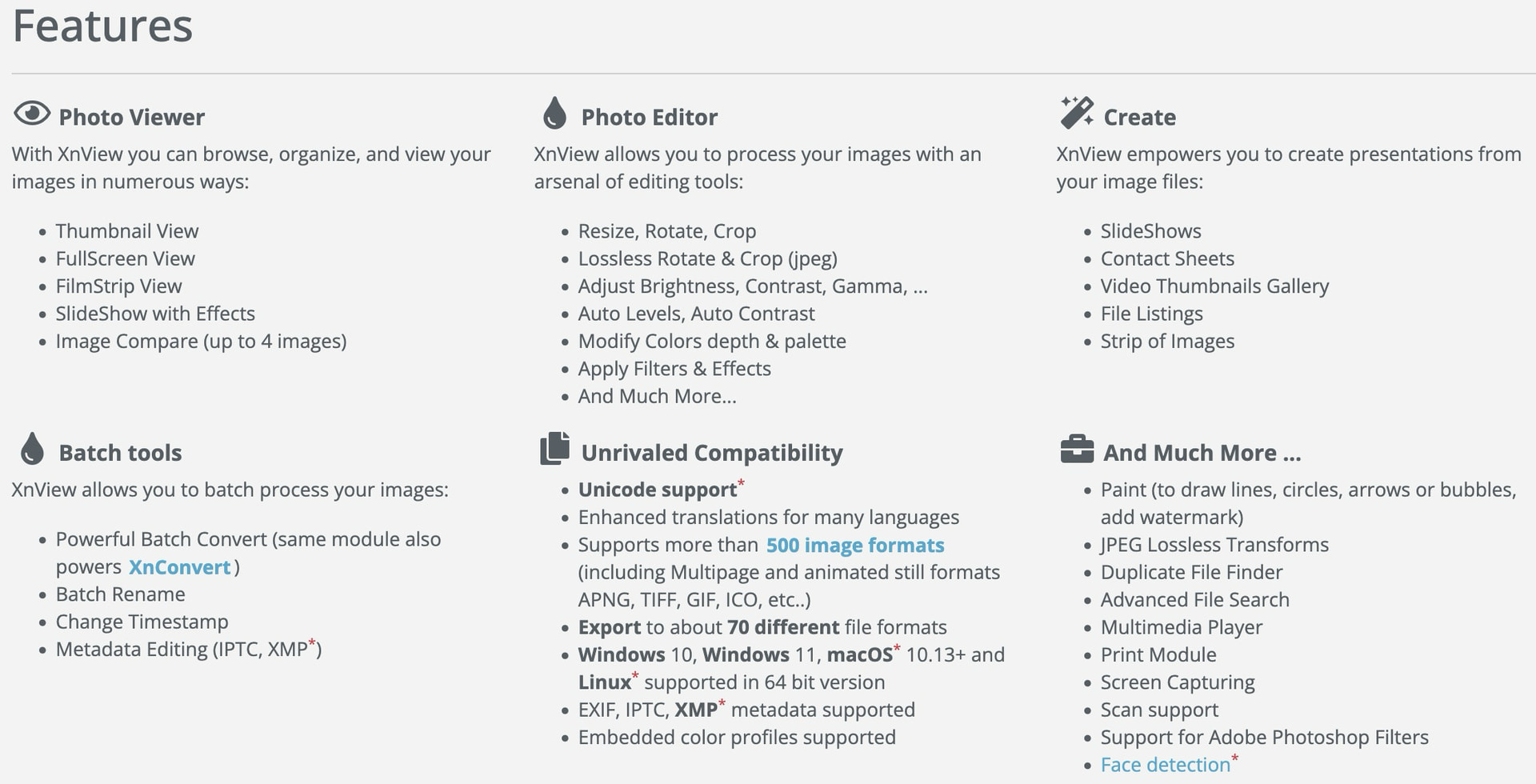
Having read through this discussion, I’ve seen lots of nostalgia for iView Media Pro, which I also used for years. Since its demise, I’ve been using XnView MP, which is a free alternative, very close in its feature set to iView:

It’s not beautiful, fancy, or modern looking – okay, it’s not even pretty – but it’s highly functional, reliable, frequently updated, and – oh yes – free!

It’s cross-platform (for those who care) and it has a long feature list:

As with iView, I find its batch processing features especially useful.

1 Like