Indeed. There is no “switch-over” lag (none) when the grid power fails. The standby generator automatically starts within a minute to continue the recharging process and run the the AC-powered HVAC and a few other things.
Back in the monopoly days, the shore power serving perhaps the largest section of suburban Omaha failed. This included the telco switch (Central Office). The standby generator started but experienced a catastrophic failure within minutes and shut down.
Anyone with working knowledge of the flooded lead acid battery knows that you do NOT run them dead. They will “sulfate” and the plates warp. You can permanently destroy such a battery by running it until it’s dead.
The grid outage was protracted and the Central Office technician, in an extremely rare move, shut down the dialtone to save the battery when it depleted to a deep degree. Since then, all Central Offices, despite each being equipped with a standby generator, have been retrofitted with external power ports to which a large, trailer-mounted generator can be attached.
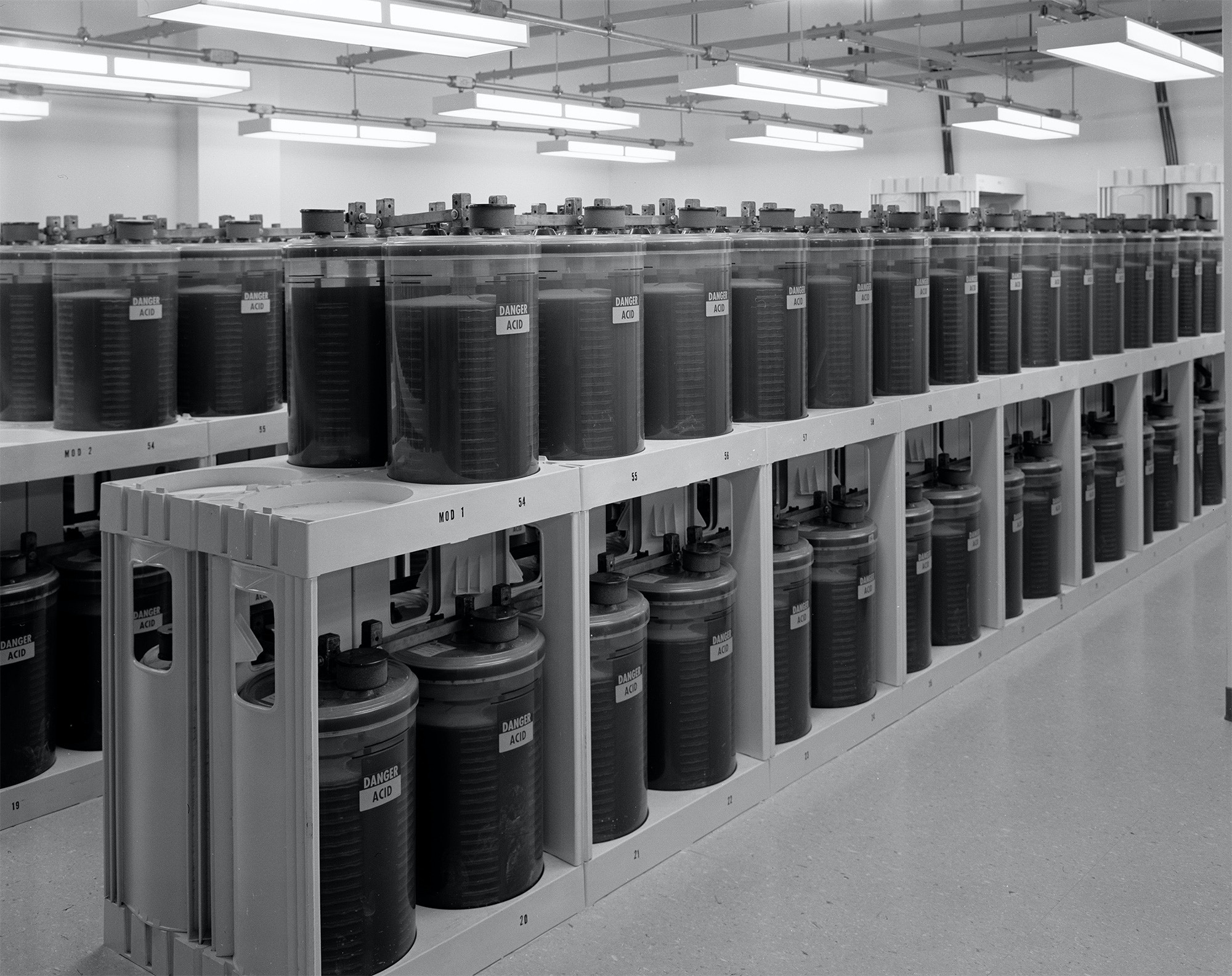
I found an image that is representative of what’s in use today. I see someone has already posted a photo. I’ll still post mine. It is representative of an OLDER battery. When “my” C.O. was upgraded, the battery, which had been on a couple rows of LONG shelves, was replaced with an entire ROOM and perhaps twice the storage capacity. The new cells were rectangular and presumably of the same capacity.
This is the part of “alternative” energy of which most proponents are unaware. From an environmental perspective, there is much to be concerned about, not the least of which is lead. The burden on the environment in the manufacture of these batteries is surely considerable. The same must be considered at the end-of-life.
Of course, such batteries are not part of most wind and solar operations. Those are just “peaking” add-ons to the common grid. When the wind isn’t blowing or the sun isn’t shining, the grid operators just burn more fossil fuel to meet demand.
It’s the “isolated” town or three in Alaska that have created a stand-alone, public power system that uses such a battery (above). The biggest impediment to “alternative” energy isn’t the generation of the power. It’s the STORAGE. We still have a long way to go.