Upgrading apps on macOS looks like we can pick macOS, vs iPhone vs ipad.
I didn’t see that for awhile so looks like I’ve been updgrading all. Shoujld I delete the iPad and iPhone ones on my macOS or just leave them on there. This confounds me.
Thank you. Patrick
I’m not sure, but I think you might be confusing installing an iPhone or iPad app on macOS, with upgrading an existing app on one of the first two platforms. Could you give a specific example of an app that you’re attempting to “upgrade”?
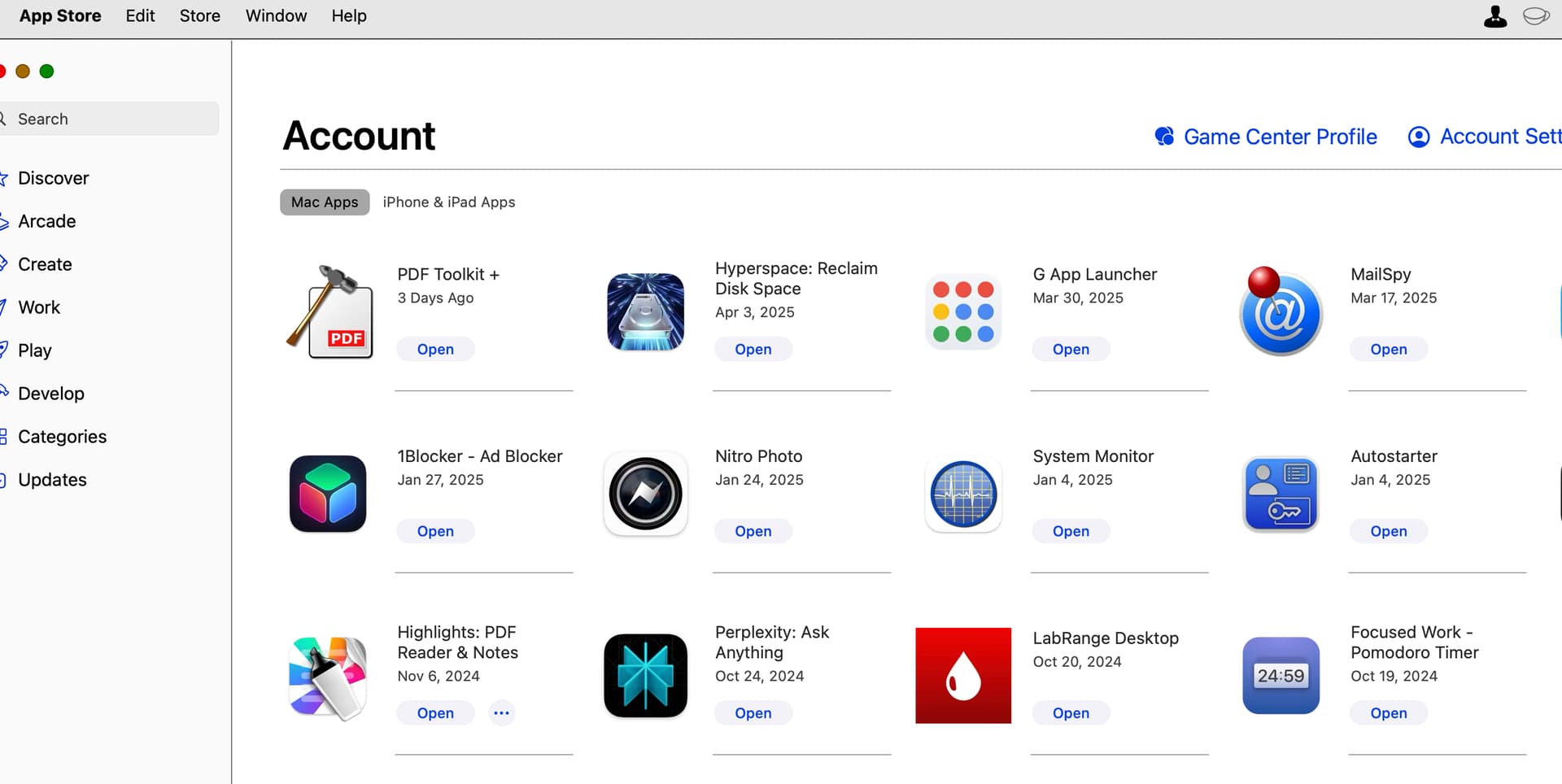
What might be happening is that App Store is showing you, on the Account page, the apps downloaded with your Apple ID.
Some version of MacOS back it became possible to run iApps on MacOS.
So perhaps this is their way of giving you options on what open/download/update.
Your screenshot shows the Account page, from which you can update/download/open the apps. If you are trying only to update your Mac apps, consider the Updates view at the bottom of the sidebar list. In my case this shows only MacOS apps but it’s possible I haven’t downloaded any iApps on this Mac. I did try it once or twice when I learned about it but didn’t find it useful for my use case.
Maybe if you’re actively using iApps on MacOS the Updates view would show both…
What @TBTdn said.
If it helps making things clearer, your screenshot tells me you are on your Mac, looking at the App Store’s Account view (Store > Account), with the filter toggle set to “Mac Apps”. On this view, you see all the Mac apps you’ve ever obtained from the App Store under your Apple ID, plus an indication of whether they’re currently installed (all the ones in your screenshot are; any that are not would be indicated by a download icon replacing the word “Open”).
If you switch the filter toggle to “iPhone & iPad Apps”, you will see all the iOS/iPadOS apps you’ve ever obtained from the App Store under your Apple ID. If you choose to try it, you may download any of these apps that appear with the download icon and (at least try to) run it on your Mac. If you choose to do that for a given app, then when that app is updated, it will appear as an available update, just like any app you have installed that was intended to run on the Mac platform.
1 Like
Minor correction: you will see all the iOS/iPadOS apps you’ve ever obtained from the App Store under your Apple ID and which are enabled (by the developer) to run on a Mac.
Correction accepted. But with a tiny caveat  .
.
If you’re developing a new app and specify iOS as the target platform, by default Xcode will add iPhone, iPad, Mac, and Apple Vision as supported platforms. (Interestingly, if you specify macOS as the target platform, that’s the only platform added to the supported list by default.)
So I agree with your point in the sense that any developer who uploads an app to the App Store should certainly have vetted the supported platforms list before doing so. But it’s just possible that he or she simply took the defaults for their new iOS app, and in so doing did not explicitly enable the app to run on a Mac.
It’s also worth pointing that all of this applies only to Apple silicon Macs. Intel Mac users won’t see options to download, run, or update iOS apps on their Macs.
2 Likes
Thank you all (Thank Y’all) as I did not know I could switch between macOS and iOS. So, for clarity sake, even though I am on macOS, this is the unit I sync w my iPad so it downloads to Applications and takes up space. I wish there was a way to ‘offload’ apps destined for iOS to save space on the mac. Thanks, again. Patrick
No iPhone or iPad apps takes up space in Applications, except for those you choose to download. Look at your screenshot. Below “Account” “Mac Apps” is selected. Open your App Store app and click the text “iPhone & iPad Apps” .
Here is an example of one that is and one that is not on my mac.

I think I may understand the confusion.
You say you are sync’ing your iPad with this Mac. I assume you’re concerned that when making a backup of that iPad, copies of its apps will end up on your Mac.
Rest assured that this isn’t the way it works. When you back-up an iPad (or iPhone or iPod Touch), it only backs up your application data. The apps themselves are not backed up, only metadata (the list of apps you have installed and where you’ve put the icons). When you restore a device from a backup, the apps are re-downloaded from the App Store as a part of the process (or shortly afterward).
And although I realize this is not what you want, if you would want to back up the apps themselves (e.g. in case Apple deletes it from the App Store in the future, or if you want to restore a specific version), you would have to do that with third-party software. I know that iMazing has that capability.
1 Like