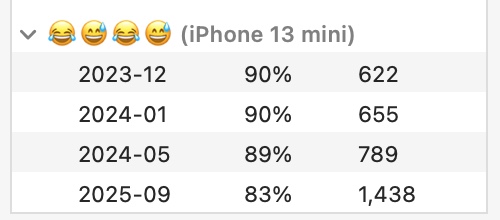
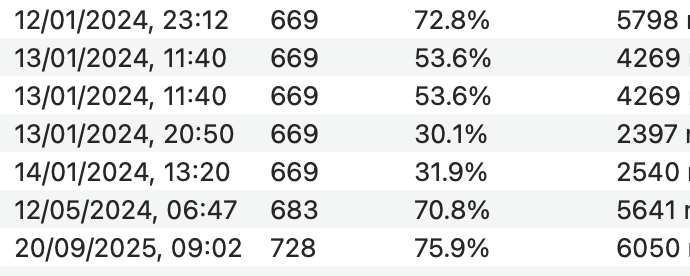
I was told recently that my iPhone’s battery health has just dropped to 79% and had to be replaced, while on Coconut Battery said it still has 83% in which the difference is quite big.
While I understand the figures can’t be accurate, I am curious about how they estimate it.
My phone’s battery degrades fast due to last year’s wireless charger and recent iOS 26 update which brings more heat.
Utilities know the exact full charge capacity of the battery. The health percentage is “Design capacity” divided by current full charge capacity. But what is the Design Capacity of the battery?
That’s where the variance is. For example, coconutBattery reports my iPhone’s design capacity as 3349 mAh, but iMazing says it is 3329.
Google says both apps are reading low-level data from the battery’s System Management Controller (SMC), but may be interpreting it differently. And the original capacity varies from individual unit to unit; does the app report the factory-rated capacity or the reported capacity? Average it out? Report whichever is less?
Google says that iOS doesn’t use the raw data, and instead a “defensive” calculated value. I don’t know if that means it wants to err on the high side, or underestimate.
I am thinking if Apple has an algorithm to put my usage into consideration because they know mine well much more than thirty-party apps.
Third-part apps get the empirical data here and now which is independent of my usage habits, while Apple foresees my battery will die fast based on the fact in the past the phone got very hot and I charged at least twice a day!
That’s why I wonder if Apple “lowers” the number to trigger my actions to protect my battery or get it replaced.
An obvious difference is the rated mAh capacity of the battery as per Apple vs. the actual mAh capacity of the specific battery in your specific iPhone. On my Macs I have seen a couple % difference on day one (and FTR, usually in my favor). I could imagine iOS will known what that day-1 capacity was but perhaps not expose it, leaving 3rd party battery apps to just assume it was equal to Apple’s quoted spec, thereby giving a systematic difference between the two estimates.
This answer is for Macs but I believe the same applies for phones and iPads.
All third party apps use the readily available ioreg parameter. Terminal instruction in this post.
Since the ioreg value goes up and down (as seen in that link) I suspect Apple knows this and doesn’t want loads of customers applying for replacement batteries as soon as Coconut says it has dropped to 80%, so they have a different algorithm which is much more stable and doesn’t increase in value (AFAIK). I have never seem any info about the Apple method.
Since all batteries vary a bit the ioreg can show more than 100% on a newish device. I have never seen the Apple number more than 100%.
As you indicate, the 80% value is important for warranty and Applecare purposes. I guess the message is … don’t assume the non-Apple (eg Coconut) measurement will result in Apple agreeing to repair the phone (or iPad). Last year they replaced my iPad under Applecare because it was just below 80% and a replacement battery was no longer available (although discontinued they located to same model sent me that). I think Coconut reported about 75%.