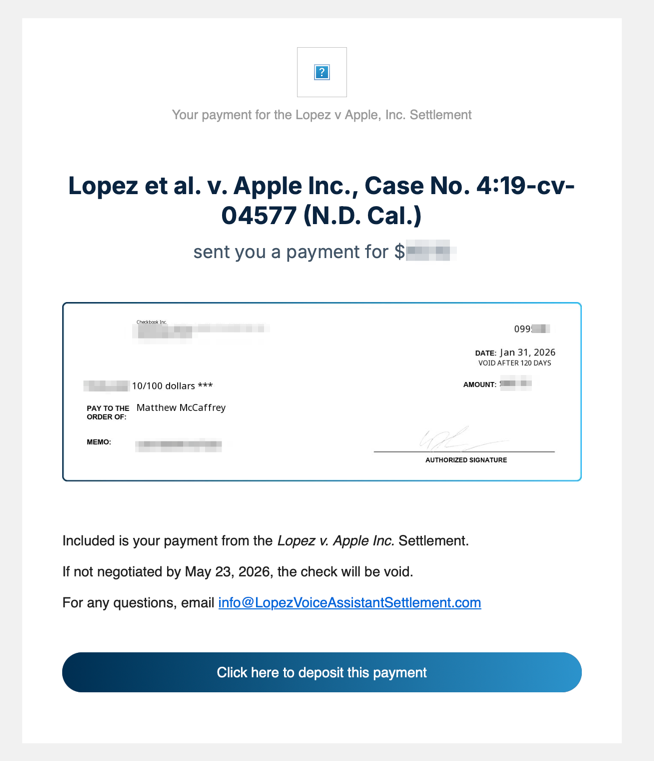
If it is not obvious from the screenshot, this is an image of what looks like a check, with the exception of the familiar MICR numbers at the bottom, bank information, or routing numbers. The details are familiar (I know who Apple Inc is (!), I remember filing a claim under the settlement terms of this class-action suit that had to do with unintentional Siri activations, and so on).
I have no idea who “ClearPath Payments” (the sender) might be, or who “Checkbook Inc” is. The check as I said is an image, and there is a link labeled “Click here to deposit this payment.”
After much research this morning, I am reassured that the payment itself is legitimate, but the company handling the payouts sure looks sketchy. I ended up giving them direct deposit information for my Venmo account, which should be a one way conduit that discloses nothing about my actual bank accounts. I’d recommend others do something similar if you are in line to receive a payout from this settlement.
I can’t figure out why a legal firm would contract out payments to a class in such an obviously suspicious manner, but I have a couple of guesses:
The “Checkbook Inc” and “ClearPath Payments” entity was the low bidder on this job, and that was the only criterion the law firm used.
Any settlement money that does not clear by May 26, 2026 goes into a secondary pool, benefiting both the class plaintiffs and the lawyers. There will likely be many who don’t claim their money because of the method used to offer it.
I believe that we are now actually seeing the “peak enshittification” that Cory Doctorow has been describing for some time. Making this kind of payment as frictionless as possible is good for the recipient. Making it look like a phishing email is good for nobody at all.
I received a direct deposit to my bank account about a week ago. The only notice was an email from my bank about the deposit, noting that it was from ‘Lopez Voice Asst Payouts’.
Apparently, when you filed a claim back in the spring, you chose to receive a digital check. The case home page says:
"Class Payment distribution commenced on January 23, 2026. Please be patient as physical checks, ACH deposits, and digital checks can take some time to arrive. If you have any questions, please reach out to us here.
Digital checks will arrive via an email. Please be sure to check your spam folder. If you selected a digital check and do not see your payment email within one week, please contact us for further investigation or reissue."
Yes, and of course “back in the spring” was the first and last time I ever thought about this particular settlement.
Against the larger background of the Wide World of Webscammery, neither the notice you received nor the suspicious-looking “digital check” I received seem adequate to establish a transaction’s legitimacy. These past few years have trained many of us to view unusual messages with suspicion.
I would worry about a deposit notice from my bank with such a cursory memo and no confirming or explanatory message from the payer.
When the deposit arrived, I did a web search on ‘Lopex Voice’ to figure out what it was. After checking the settlement page, I was convinced it was legitimate. Within a few days, articles on the settlement appeared in on the CBS News and USA Today websites.
So, yes, the actual notification associated with the payment was sketchy, but it is easy to verify its probable legitimacy. For example, here is the response when I entered ‘Lopez Voice Settlement’ in Perplexity (useful mainly for source references).
And that’s a good strategy. Personally I checked the subreddit /scams before I did anything. It offered plenty of other experiences and suggested using the Venmo direct deposit as a circuit breaker between the payment and my accounts.
Since this hit my email box this morning I did not have the benefit of media stories to confirm that payments were going out.
Just wanted to share what I decided to do with the virtual check. Thanks to all the previous posters in this thread; the information is very helpful.
Venmo users need to treat the virtual check as a direct deposit. This must be set up on the iOS/iPadOS app, not on the Venmo website.
Venmo direct depost requires a verified identity that involves submitting the sort of information needed to open a bank account.
Providing bank account information to the virtual check-vendor sets up an ACH channel between your bank account and the vendor’s bank account. This is similar to how direct paycheck deposits and links to stock broker accounts are established.
My Venmo account isn’t identity verified. I have a secondary checking account that has a low balance pretty much all the time and isn’t used for anything important or critical to my daily life. So I chose to use the checking account for the virtual check deposit. After the funds are received, I will check the list of ACH connections on the account to see if I can delete the connection to the vendor myself. If not, I’ll see if there are any ways to block the vendor from ACH access by talking to the bank.
——————————
ETA: The funds were transferred. It does not look like a permanent ACH channel was established between my bank account and ClearPath Payments/Checkbook Inc. I think, then, that if you receive one of these payments and you are already a verified Venmo customer, using Venmo is the way to go. Otherwise, depositing a paper check and receiving the ACH transfer in a bank account are similar from a privacy and security standpoint. Either way, the payment vendor will see your bank details at some point in the process.