Pages, Keynote, and Numbers 15 Go Freemium

Originally published at: Pages, Keynote, and Numbers 15 Go Freemium - TidBITS

Although the marquee apps in Apple’s new Creator Studio bundle are Final Cut Pro, Logic Pro, and Pixelmator Pro, the company also tossed in Pages, Keynote, and Numbers—the apps previously known as iWork—along with the FreeForm collaborative whiteboard app (see “Apple Bundles Pro Apps into New Creator Studio Subscription,” 15 January 2026).

The addition of the iWork apps complicated the situation because Final Cut Pro, Logic Pro, and Pixelmator Pro are paid apps and remain available to existing users and for new purchases (at least the Mac versions; the iPad versions are now available only to Creator Studio subscribers). In contrast, Pages, Keynote, and Numbers are free, as is Freeform, so why would anyone bother subscribing to get them again?

What Subscribers Get

To sweeten the Creator Studio deal, Apple integrated the Content Hub—a curated clip art library of photos, illustrations, and graphics—into the iWork apps, plus added new templates and OpenAI-powered image generation, editing, upscaling, and cropping. Sure, Apple has good taste, but I can’t help feeling that the product managers of any mature app that adds a clip art library are suffering from a lack of vision and creativity.

The Content Hub in Pages 15.1

In addition:

In addition, all three have received interface updates to Liquid Glass, which some view as a bug rather than a feature.

A Bumpy Upgrade

The transition from version 14.4 of Pages, Keynote, and Numbers to version 15.1 has been confusing, to say the least. In late January, Apple released version 14.5 of all three apps, with the App Store claiming “This update contains bug fixes and performance improvements” for all three. I wonder if even that is true, given that 14.5 doesn’t appear in the version history for any of them.

The actual change in 14.5 is a dialog that appears at launch, informing the user that 14.5 will no longer receive updates and directing them to download version 15 from the App Store.

iWork app upgrade dialogs

When you click the Go to App Store link in each of these dialogs, you’re taken to the appropriate page to download version 15.1. (There’s no indication of what happened to 15.0.) Although people have complained about having to search the App Store manually for these apps, the links do work properly. You’ll also notice that Apple has stuffed marketing keywords into the app names—“Pages: Create Documents,” “Numbers: Make Spreadsheets,” “Keynote: Create Presentations”—a practice the company has long tolerated from other developers but now appears to be embracing.

Subtitles in the iWork App Store names

I presume Apple couldn’t upgrade the version 14 apps in place because they also needed to build them into the Creator Studio subscription, as the App Store isn’t known for providing developers much flexibility in their marketing and distribution. There’s a little schadenfreude in seeing Apple suffering from this as well.

Because the version 15 apps are entirely new, they coexist in the Applications folder with the version 14.5 apps. You might wonder how that’s possible, since they appear to have the same name in the Finder. The Get Info window shows that the new version of Pages is actually called “Pages Creator Studio.app.”

Comparing Pages app names

Although the old and new versions can coexist, Apple isn’t happy about it. Whenever you launch Keynote 14.5 or Numbers 14.5, you’ll be encouraged to delete them. Oddly, I don’t get a similar dialog with Pages.

Delete Me dialogs

The practical upshot of all this is that you can continue to use the 14.5 versions, presumably indefinitely. They won’t receive updates, and Apple has already fixed security vulnerabilities in Pages and Keynote that could cause a crash or disclose process memory when processing a maliciously crafted document.

Note that version 15.1 requires macOS 15.6 Sequoia or later, while version 14.5 supports macOS 14.0 Sonoma and later. If you’re running an older system, 14.5 may be your only option—download it now while it’s still available in the App Store. On the plus side, files created in version 15.1 can be opened by version 14.x and vice versa, so there’s no compatibility concern if you’re collaborating with someone on a different version.

If you haven’t updated anything yet and are willing to live without future updates for a while, it may be easiest to stick with the 14.4 versions that won’t nag about anything at launch. But that’s not a long-term strategy.

A Rocky Reception

Although Apple doesn’t appear to have removed any features, so no one who upgraded is functionally worse off than before, there have been numerous complaints, as reflected in the App Store ratings. Pages dropped from 4.6 stars to 2.5, Keynote from 4.7 to 2.1, and Numbers from 4.6 to 2.1. And these are presumably Apple’s most involved users, since they’ve downloaded the upgrade so quickly.

Complaints have focused on:

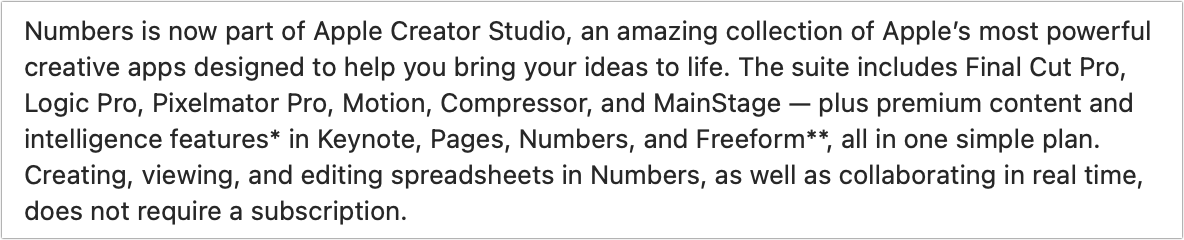
  • Confusion about whether the apps are still free: Many users have seen the Creator Studio branding and subscription prompts and assumed they now had to pay for apps that were previously free. It’s not the case, but Apple has little incentive to make that crystal clear. In the App Store descriptions, after emphasizing that each app is part of Creator Studio, a single sentence states that “creating, viewing, and editing” and “collaborating in real time” do not require a subscription. That reads a lot like the mealy-mouthed way the limited features of freemium apps are often described, and is a far cry from “all existing features remain available for free.”Image
  • In-app upselling: The new versions include toolbar buttons, menu items, and a first-launch screen promoting Creator Studio. Premium templates are mixed in with free ones in the Template Chooser (and shown first), and if you try Content Hub items without subscribing, they’re watermarked.
    Keynote 15.1's Theme picker
  • No way to hide premium content: Users can’t filter out Creator Studio templates from the Template Chooser, so they must scroll past subscription-only items to find the free ones every time they want to create a new document.
  • Liquid Glass interface changes: Apple continues to claim that Liquid Glass is an improvement, and although opinions vary, most I’ve heard dislike it. Speaking as someone who hates icon-only interfaces, I will note that you can still choose View > Customize Toolbar and choose Icons and Text from the pop-up menu at the bottom of the dialog to return text labels to the otherwise incomprehensible toolbar icons. If you don’t subscribe to Creator Studio, you might also remove all its purple toolbar icons.
    Customizing the Keynote 15.1 toolbar
  • The new icons: Many people are unhappy about the abstract, “neon” icons replacing the more photorealistic ones. While I’m sympathetic, they aren’t nearly as bad as some of Apple’s other Liquid Glass-driven icon redesigns. I have to wonder whether the Numbers icon expresses the designer’s disdain for Liquid Glass or the community’s criticism of it.
    Apple Creator Studio iWork icons
  • Freemium freakout: Users are legitimately concerned that these few AI-powered features are merely the beginning, and that all future enhancements will be locked behind the Creator Studio paywall. With the other Creator Studio apps, users can at least choose between purchasing standalone versions and subscribing, but iWork users have no such option if they want the new features. To be fair, the AI features incur ongoing costs because they don’t use local models, so Apple has more justification to want ongoing revenue from them.
  • Content restrictions: I haven’t actually seen anyone complain about this yet, but if you read the Apple Creator Studio License Agreement, which you agree to by clicking Continue on the first-launch splash screen, you cannot use anything from the Content Hub as standalone files outside of Creator Studio apps. You also may not incorporate content into a logo, corporate ID, trademark, or service mark; use it in a pornographic, defamatory, or otherwise unlawful manner; or use it for training, testing, or evaluating any machine learning or artificial intelligence models. I imagine such limitations are common with clip art, but they’re worth keeping in mind.

Ultimately, adding Pages, Keynote, and Numbers to Creator Studio feels wrong. Yes, it will likely encourage (or mislead) more people into subscribing to Creator Studio and thus boost Services revenue. But it smacks of squeezing incremental revenue from existing products rather than creating compelling new value. Of course, that raises a question: if users aren’t clamoring for new features in these mature apps, perhaps monetizing the margins is all that’s left.

As for what you should do, it’s hard to see a significant risk in continuing to use the iWork 14.4 or 14.5 apps. If you were concerned about receiving potentially malicious Pages or Keynote documents, you could open them using the iWork 15.1 versions. Simultaneously, it’s easy enough to download the iWork 15.1 apps, so you can see if you are perturbed by Liquid Glass and the Creator Studio upsells. And if you find the Content Hub and AI-powered features genuinely useful, the subscription might even be worthwhile.

5 Likes

A sad day. I don’t need the *(what_ever)intelligence. Think Linux is next. Also in my mind: #Greenland Apple’s behavior is … Goodbye

2 Likes

If your right-click on the app and select “Show Package Contents”, to see the inside of the app bundle, and then view the file Contents/info.plist (QuickView will work), you can then view the metadata that the Finder (and launch services) uses for the app.

I don’t have version 15 at this time, but looking at the plist for version 14.5, I see two keys whose values are “Pages”:

<dict>
    ...
    <key>CFBundleExecutable</key>
    <string>Pages</string>
    ...
    <key>CFBundleName</key>
    <string>Pages</string>
    ...
    
</dict>

I suspect that the first (CFBundleExecutable) is the name of the internal executable file (in this case. Contents/MacOS/Pages), and the second (CFBundleName) is the name presented in the Finder.

Can you share the corresponding keys in version 15?

I suspect they’re doing something similar to what Microsoft has done ever since introducing their XML-based Office document formats. If you look at (for example) a .docx file, it is actually a Zip archive. If you unzip it, you’ll get a directory full of various files, including an XML representation of the document.

This allows for forward- and backward-compatibility. If you use a new feature from a new version of the app, and try to load the document into an old version of the app, it should (I assume) ignore the XML keys it doesn’t understand and load the rest. So you’ll be able to see as much as possible with the version of the app you have.

And if the app is well-written, then unsupported keys should be preserved when saving the file, so they won’t get lost, and the corresponding formatting/functions will remain there when the document is later reloaded into the current version.

At least that’s my assumption. I could be completely wrong.

2 Likes

I‘ve been familiar with the phrase “Death by a Thousand Papercuts” for a few decades, but over the last few years I’ve been feeling like this might be Apple’s unofficial motto. “Freemium” Pages, Keynote, and Numbers—well, here’s a few more papercuts. Frankly, it barely hurts after the rather large gash that was Liquid Glass—but at a certain point, Apple’s gotta stop making us bleed. Or soon they’re gonna be bleeding customers.

8 Likes

I use all three apps nearly every day now and I’ve used all since their original launches. I have never used any template bar ones I’ve created. The upselling is painful, it’s not just in the new document picker, it appears in the sidebars as well, so it’s not just a “wade through all these to get to my templates and then dismiss” irritation, there’s a sense you can’t avoid this.

My one hope is someone in Apple will dial it back in an update.

8 Likes

The message Jason Snell saw that said he could delete 14.5 is the one you get when you run one of the 14.5 versions after downloading the new version. If you haven’t downloaded the new one yet then you get prompted to do so instead.

3 Likes

Whether you think this Creator Studio/freemium debate is valid or not, to me it all feels like a distraction from the real issue with Keynote, Numbers and Pages: their collaboration features are in desperate need of additional development. Inviting other users to work in these docs, managing those users, viewing docs on the web, commenting, versioning and other similar features could all be much, much more elegant, lower friction and more reliable. It’s sad that such genuinely terrific apps are stuck in an early 2010s mode of collaboration because they could be so powerful if updated. For the record, I would gladly pay for Creator Studio if Apple upleveled them along these lines.

4 Likes

Pages Numbers and Keynote (14.5 version) are not available in the App Store for Tahoe? I unhid all three and I can’t find them in my list.

I know it’s a petty complaint, but the fact that the new programs don’t list any of my old files in the “Open Recent…” dialog really messes up my workflow. I have numerous files that I open regularly. Yes, I will eventually repopulate that dialog. But for now, I’ll stick with the old program just to not have that annoyance.

And no, I see nothing worth paying for in the new offerings.

1 Like

Thank you for another great article Adam! I just went to see the comments in the Mac App Store today and the majority are people complaining about the new versions, after all these years people gave them for granted… not looking good for Apple.

2 Likes

The majority of poor ratings seem to be because people assumed incorrectly that they had to pay for what has previously been free.

@sgtaylor5 I was surprised to read this, so I checked App Store on my Mac (I’d updated to 14.5 recently). I didn’t find those apps in v14 by searching the main store, but checked in my Account’s Purchased section and there they were. I‘m not 100% clear where you were looking, though it sounds like you were in your Account section, so that is weird.

Just to reiterate, the new 15.x versions of these apps are functionally identical to the 14.5 versions. It is my understanding that the code base has undergone a major rewrite prompting the need for a fork in the upgrade path, but both versions work on the same files and a file opened in either version can be opened and edited in the other.

The fact that there is a possibility of paying for some extras doesn’t affect the performance of the apps. And, for me, the presence of reminders of those extras in the new apps is not a bother.

5 Likes

Just a reminder that you can give direct feedback to Apple. The relevant team will get to read this.

6 Likes

I was looking in Hidden Purchases in my Apple Account, through the Mac App Store. When I clicked on "Unhide”, those three apps came off the list in Hidden Purchases, but didn’t show on my master list of available apps when I selected the entry for my user name at the bottom of the App Store sidebar.

EDIT: I just looked, and there they are…

1 Like

Isn’t Apple breaking a contract since they have promoted the iWork apps as free of charge when buying one of their devices? Maybe a harder hitting headline is appropriate here.

And frankly Apple has played yo-yo with these apps since 1984 –

free

not free

free

not free

free

not free

No I am not going to go back 40+ years to put a date next to these.

Y’all know what I am talking about.

1 Like

Isn’t Apple breaking a contract since they have promoted the iWork apps as free of charge when buying one of their devices?

They are still free!

3 Likes
  1. What contract? Advertising copy is very rarely considered legally binding.
  2. These apps started out as paid ($100 for one license or $130 for a family pack, I think) when they were sold on DVD.
  3. The version bundled with your hardware (up to version 14.5) isn’t going away. Yes, you get an alert telling you that Apple would like you to switch, but the app is still there and still works.
  4. The new version only requires payment for a few AI/cloud features. Everything else is still free.
3 Likes

Pages has existed since 2005. Numbers since 2007. Keynote since 2003.

3 Likes

LOL I asked around and got tis answer

APPLE WORD PROCESSING / OFFICE SUITE APPS ON macOS / CLASSIC MAC OS
(MacWrite in 1984 → current Pages “premium” era)

Note: Prices are historical US list prices where documented; street prices/promos varied.

1. MacWrite (1984 → early 1990s)
   - Type: Standalone word processor for original Macintosh.
   - Platform: Classic Mac OS (System 1+).
   - Distribution / Cost:
     - 1984: Bundled with the original Macintosh along with MacPaint.
       - Cost to user: $0 incremental (included in Mac price).
     - Later sold by Claris as MacWrite II / Pro:
       - Typical boxed word-processor price band for the era: ≈US$99–$149, but exact SKU-specific list prices are not consistently documented.
   - Role:
     - First mainstream Mac word processor from Apple; ancestor to later Claris works/office tools.

2. AppleWorks (Macintosh) via ClarisWorks rebranding (late 1990s–2004)
   - NOTE: The original 1984 AppleWorks was Apple II‑only. On Mac, “AppleWorks” is essentially:
     - ClarisWorks (1991–late 1990s) → renamed AppleWorks 5 / 6 under Apple around 1997–2000.
   - Type: Integrated office suite:
     - Word processor.
     - Spreadsheet.
     - Database.
     - Drawing.
     - Painting.
     - Communications (early) / Presentation (v6).
   - Platform:
     - Classic Mac OS (System 7 → Mac OS 9).
     - Mac OS X (via Carbon in AppleWorks 6).
   - Development milestones (Mac):
     - ClarisWorks 1.0 – Oct 1991 (Mac) – integrated suite [AppleWorks][1].
     - ClarisWorks 2.0 – Mar 24, 1993.
     - ClarisWorks 3.0 – Oct 1994.
     - ClarisWorks 4.0 – Jun 14, 1995.
     - ClarisWorks 5.0 / AppleWorks 5.0 – Aug 24, 1997.
     - AppleWorks 6.0 – Jan 2000 (adds presentation module, Carbonized for OS X) [AppleWorks][1].
   - Pricing on Mac:
     - New license (1990s integrated suite market):
       - Typically in the US$99–$149 range list for boxed versions; often discounted.
     - Bundling:
       - Widely bundled on consumer Macs (e.g., Performa line, later iMacs) at $0 incremental cost to user, for many years [LowEndMac][2].
     - Late life example:
       - AppleWorks 6 was still sold around 2004 at US$79 retail; Low End Mac notes it as “For $79, it’s a steal” [LowEndMac][3].
   - Discontinuation:
     - Aug 15, 2007: Apple declares AppleWorks end-of-life; no longer sold; iWork is positioned as the replacement [AppleWorks – Discontinuation][1].

3. iWork ’05 (Mac) – Keynote 2 + Pages 1.0 (2005)
   - Type: Office suite for Mac (DVD/CD box).
   - Components:
     - Pages 1.0 – word processing + page layout.
     - Keynote 2 – presentations.
   - Release:
     - Announced Jan 11, 2005; shipped Jan 22, 2005 [iWork][4].
   - Platform:
     - Mac OS X 10.3.6+, PowerPC.
   - Cost:
     - iWork ’05 suite: US$79 (boxed).
     - No separate per‑app Mac App Store pricing yet.

4. iWork ’06 (Mac) – Pages 2.0 + Keynote 3.0 (2006)
   - Components:
     - Pages 2.0.
     - Keynote 3.0.
   - Release:
     - Jan 10, 2006 [iWork][4].
   - Platform:
     - Mac OS X 10.3.9+, first universal binaries (PowerPC + Intel).
   - Cost:
     - iWork ’06 suite: US$79 (boxed).

5. iWork ’08 (Mac) – Pages 3.0 + Keynote 4.0 + Numbers 1.0 (2007)
   - Type: First “full” 3‑app office suite from Apple on Mac.
   - New component:
     - Numbers 1.0 – spreadsheet [iWork][4].
   - Release:
     - Aug 7, 2007.
   - Platform:
     - Mac OS X 10.4.10+.
   - Cost:
     - iWork ’08 suite: US$79 (boxed).

6. iWork ’09 (Mac) – Pages 4.0 + Keynote 5.0 + Numbers 2.0 (2009)
   - Components:
     - Updated Pages, Keynote, Numbers [iWork][4].
   - Release:
     - Jan 6, 2009.
   - Platform:
     - Mac OS X 10.4.11+ (DVD), later Mac App Store.
   - Cost:
     - iWork ’09 suite (DVD): US$79.
     - Later (Jan 2011 onward, Mac App Store split pricing):
       - Pages (Mac): US$19.99.
       - Numbers (Mac): US$19.99.
       - Keynote (Mac): US$19.99.  [iWork][4]

7. Post‑’09 iWork on macOS (App Store era, before fully free)
   - 2011–2013:
     - Distribution shifts primarily to Mac App Store.
     - Pricing remained:
       - Pages (Mac): $19.99.
       - Numbers (Mac): $19.99.
       - Keynote (Mac): $19.99.
   - Major on‑Mac releases (examples from iWork version table, all paid updates in this era):
     - 6.0+ line (Oct 22, 2013):
       - Rewritten iWork apps for OS X Mavericks and iCloud compatibility.
       - Still $19.99 each for users without “free with device” entitlement.

8. 2013: “Free with new Mac” shift (OS X)
   - Policy change (Oct 22, 2013 event):
     - Any OS X/macOS device purchased (new or refurbished) after Oct 1, 2013 is eligible for:
       - Free downloads of Pages, Numbers, Keynote from Mac App Store after setup [iWork][4].
   - Pricing on Mac in this period:
     - On eligible new Macs:
       - Pages / Numbers / Keynote: effectively $0 (free entitlement).
     - On older Macs not covered by the entitlement:
       - Pages / Numbers / Keynote: still $19.99 each.

9. 2017: iWork becomes fully free on macOS (no purchase requirement)
   - April 2017 change:
     - Apple makes iWork apps free to all macOS users, including those on older Mac hardware [iWork][4].
   - From this point:
     - Pages (Mac): US$0.
     - Numbers (Mac): US$0.
     - Keynote (Mac): US$0.
   - Upgrades:
     - Subsequent major versions (10.x, 11.x, 12.x, 13.x, 14.0+ etc.) are free updates on the Mac App Store.

10. Current era (macOS 13–15+, ~2023–2026) – Pages / Numbers / Keynote & “premium” context
    - Apps:
      - Pages, Numbers, Keynote continue as the core free Mac office suite [iWork][4].
    - Latest documented Mac versions:
      - iWork 14.0 suite released Apr 2, 2024 (Keynote/Pages/Numbers 14.0) [iWork][4].
      - Article table shows ongoing 15.x as of early 2026; still free.
    - Cost model on Mac:
      - Core apps:
        - Pages: $0 (download & use).
        - Numbers: $0.
        - Keynote: $0.
      - “Premium”/advanced features:
        - Apple is transitioning toward a successor called “Apple Creator Studio” as the broader platform for content creation (iWork’s “Successor: Apple Creator Studio” is noted in the infobox) [iWork][4].
        - New higher-end or AI-assisted features are not sold as “Pages Pro = $X” but are being folded into:
          - iCloud+ / Apple One subscription tiers (various US prices depending on storage and services bundle).
        - On macOS the base Pages app remains free; any “premium” capabilities are effectively tied to those broader Apple subscriptions, not to a direct, separate Mac Pages price tag.

----------------------------------------------------------------
SHORT CHEAT-SHEET (MAC ONLY: MAJOR PRODUCTS & TYPICAL US PRICES)

- MacWrite (1984+)
  - Bundled with Mac: $0 incremental.
  - Later MacWrite II/Pro: ≈$99–$149 list (era-dependent; not crisply sourced).

- ClarisWorks / AppleWorks (Mac) (1991–2007)
  - New license: Typically ≈$99–$149 list.
  - Bundled on many Macs: effectively $0 incremental.
  - Late AppleWorks 6 retail (c. 2004): $79.

- iWork ’05 / ’06 / ’08 / ’09 (Mac)
  - Each suite (DVD/CD): $79.

- iWork (Mac App Store, pre‑2013)
  - Pages / Numbers / Keynote (each): $19.99.

- 2013–2017 on macOS
  - New/refurb Macs (after Oct 1, 2013): iWork apps free.
  - Older Macs: Pages/Numbers/Keynote each $19.99.

- 2017–present on macOS
  - Pages / Numbers / Keynote:
    - $0 (all users).
  - “Premium” capabilities:
    - No additional Mac‑only Pages price; advanced features tied to broader Apple subscriptions (iCloud+, Apple One, etc.), which have their own monthly prices separate from Pages itself.

----------------------------------------------------------------

[1]: AppleWorks (Mac history & AppleWorks 6 details) – AppleWorks article, esp. “AppleWorks and ClarisWorks (Macintosh and Windows, 1991–2004)” and “Discontinuation” sections: https://en.wikipedia.org/wiki/AppleWorks  
[2]: Background on bundling and popularity: Low End Mac – “Apple Kills Another Great App”: https://lowendmac.com/musings/mm07/0814.html  
[3]: Late‑life AppleWorks pricing: Low End Mac – “AppleWorks May Be Discontinued, but It's Far from Dead”: https://lowendmac.com/ed/lebron/ll07/0912.html  
[4]: iWork (history, versions, and pricing evolution): https://en.wikipedia.org/wiki/IWork
5 Likes