Well, Affinity has just changed the ‘very expensive’ part. They’re no harder to learn than any other software.
I’ve uploaded entire books as PDF to Amazon KDP. I can’t see republishing being an issue if you have the original native file.
I don’t use Word (or any of its substitutes) and have always used PDF - but I typically don’t do reflowable books. I’m currently on my first attempt at something for Epub and have used Pages after it rendered a fairly good test export. My preferred choice is InDesign but getting the reflow right seemed problematic - especially if you want to also submit to multiple platforms (but I admit I have tested exhaustively).
The problem is that I did not have the original native file. The original book went through five editions, the last in 2006, and for each one new edition they just had me add changes, apparently thinking they would only need to reset the changes. It was about a fast-changing field, so there were lots of changes, and nowhere did I have an original native file. What I did was scan the book and use a PDF image PDFs for the 800 page book. I had to make small changes on a few pages and that was enough to be a pain, but it has earned me a nice profit selling PDF ebooks and print copies of the book.
Count me in the fan club; My entire computer system is FULL of Nisus documents as I have never used anything else since I met the creator at a Mac World Forum many years ago. Glad to help in any way I can as this is a great piece of software. I like the Open Source route if a buyer can’t be found.
Another factor to consider in addition to this might be the slope of the internet.
A French artist, Louise Druhl, posits that the early days of the Web had a gentle slope, which facilitated meandering, with serendipitous discoveries, let us not forget the delights of StumbleUpon, and why we called software Navigator, Explorer, Safari… Nowadays, she points out that the Web has a much steeper slope, funnelling us rapidly into fewer sites which people rarely leave. Decreasing vastness might be a fellow traveller to fewer choices.
Your ghost cities of the Internet post reminded me most clearly of the delights in Café Utne, an early pioneering online community, moderated fora with a lot of interesting characters.
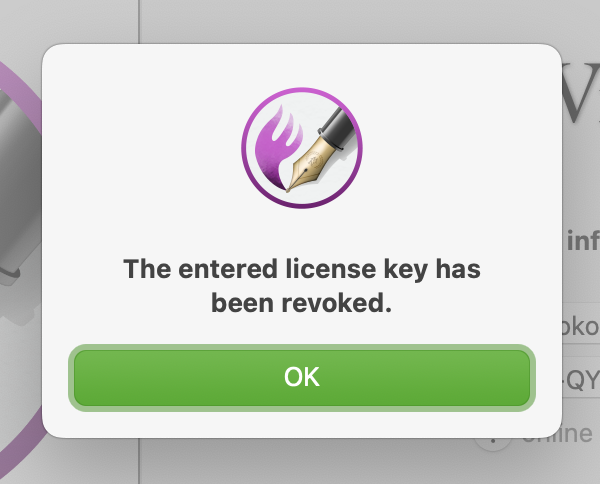
It occurred to me that this began right after I updated to Sequoia 15.7.2. Repeated re-registration attempts failed until I restarted the Mac. Then registration “took”.
This raises an interesting question. Do Nisus products phone home to continue verifying registration (a la Adobe)? Or is the certificate stored locally? If it needs an Internet connection to verify ownership regularly, what happens when the company eventually folds?
I am on macOS 15.7.1. When I quit NWP right now and then relaunched it, it had decided that I was now on day 3 of the demo period. So I re-entered my license and name, LittleSnitch told me NWP wanted to connect to nisus.com, but even when I denied the connection, NWP accepted the license. Upon a new relaunch, everything worked fine.
As of December, the Nisus “check for update” function in the app has been restored, and the nisus.com website is back, complete if unrefreshed. I have used Nisus since the late 1980s. It has evolved into much more than a great, plain text word processor, with multi-language typesetting and layout capablilities that allowed me to kick Adobe to the kerb long ago, along with MSWord. Hope the torch gets passed.
Posted in the Nisus forum (by myself): Supposing that Nisus survived, and it merged with another product/sector to revolutionise document creation and management, what would that product/sector be?
Any reports yet of problems using Nisus with OS26? I’m still holding on with Sequoia 15.7.1 but worrying about when Apple will do something that kills Nisus. My first option may be Pages but I am not sure how well it can meet my needs. Some of my writing does require Equations, which probably will force me to Word.