Our 2024 Honda CR-V has the overspeed warning tones as an option that can be turned on/off via one of the many on-screen settings. I never turned mine on because many times if I drive the speed limit I risk being rear-ended by the traffic behind me. Speed limits are often treated as suggestions by many drivers.
1 Like
That kind of attitude presumably is part of the reason for the much higher road death rates in the US. 
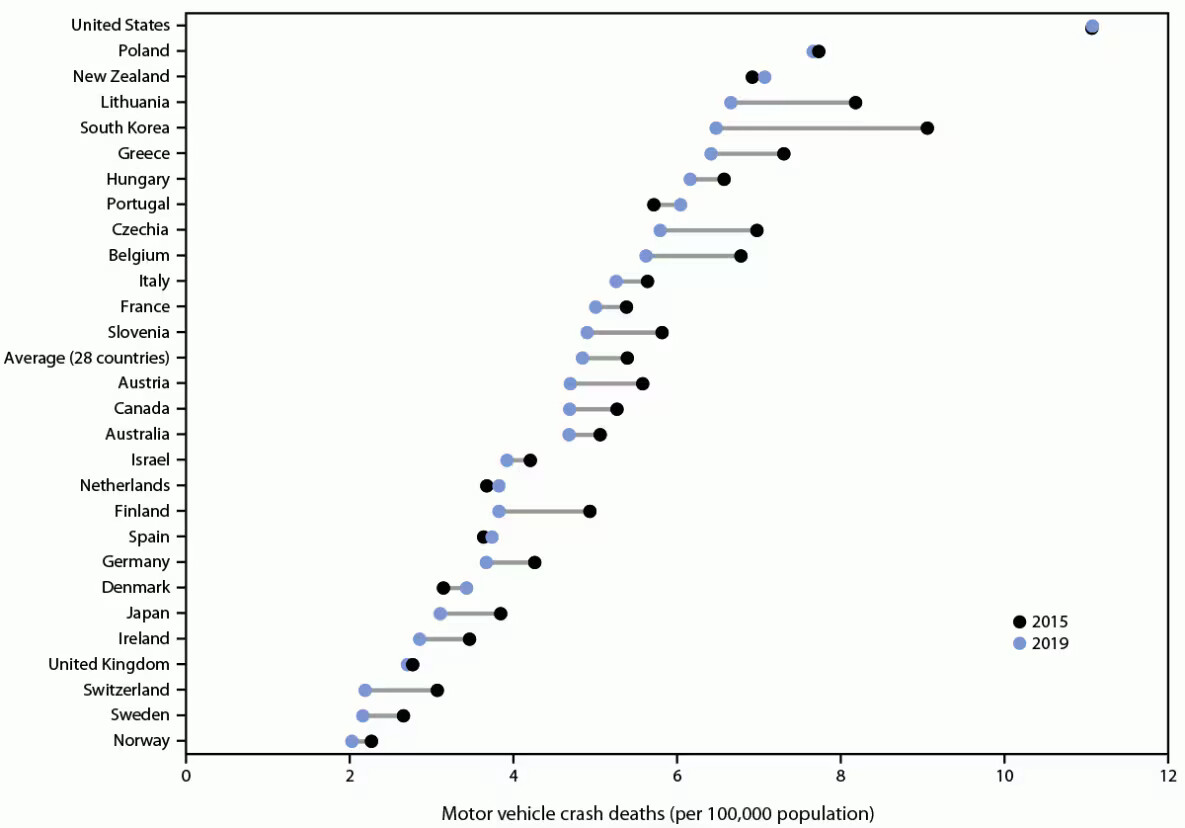
source: Motor Vehicle Crash Deaths — United States and 28 Other High-Income Countries, 2015 and 2019 | MMWR
1 Like
As a naive non-expert I see two ways to combat this: through engineering or punitive (rigorous enforcement, fines, etc.).
The latter at least here in my part of CA has been completely abolished. Nobody gets pulled over for any speeding unless it is completely bonkers. And even when cops do pull over somebody for going 15 mph over in a built up area, they openly state they prefer giving warnings instead of citations (and there’s certainly ample political pressure for that too). Nowhere else do I see people get stopped for no license, no insurance, expired tags, and then just allowed to keep on driving. Towing is racist (or some other ism) and takes too long etc. So people that openly flout the MV code are allowed to continue driving dirty, our insurance rates keep going up, and surprise surprise no other wealthy developed country has anywhere near our horrendous death toll per vehicle mile traveled. And, as @jzw’s impressive chart also shows, ours isn’t going down like other developed countries (it’s actually going up quite a bit, just check this out). In fact, 2022 set a new sad record per vehicle mile traveled.
So with the latter apparently politically impossible, I wonder about the former. How is it that we cannot engineer for less speeding? How is it that we cannot just mandate that all new cars sold, must inhibit acceleration once a driver has gone beyond 35 in a 25 or beyond 75 in a 55? I’m sure there will be plenty of people who try to deflect that the tech isn’t there, but seems to me, looking at my $700 iPhone, the tech sure is there. Of the 20k miles a year I drive, I’d say not 200 miles of it is in areas where my iPhone cannot tell me what the speed limit is, and not 20 miles of it is where its GPS cannot get my speed to within a couple mph.
So if even the low-end iPhone today can do it, and the avg sales price of a car in the US is now almost $50k (i.e. 71 times higher), does it really just boil down to us basically saying, we don’t care about the death toll and being lawful drivers, we just want to speed with impunity, 45k traffic deaths per year be damned? Is it really just that sad?
1 Like
Let’s be careful to keep this on technical topics…
John Gruber wrote about this EU legislation a while back:
In contrast, I’ve long said that I want a car that will default to driving the speed limit, while still allowing me to go faster or slower if I so decide. When I do speed, it’s seldom intentional. Usually, I’m just not quite paying sufficient attention to the speed, and since speeding tickets are commonplace in New York, particularly in places where the speed limit changes, I would be happy if my car helped me stay at the limit.
The Australian navigation app that I mention above provides reliable speed limit information and a user-selectable speeding alert based on the GPS-derived speed of the vehicle. My point is that it would be simple for Apple to add this optional feature to Maps. I understand that Google Maps has this feature in some countries like India.
Having a speed assistance system automatically limit the speed of the vehicle is a more comlex matter that was addressed in the 2017 seminar that I attended. My car has a camera-based system that, unfortunately, is not reliable. But it also has a manual speed limiter that uses the same buttons as cruise control. Once I reach a desired speed I can simply press a button on the steering wheel to engage and engage it.
When you think about it manual cruise control prevents a vehicle from travelling less than a chosen speed without driver intervention. A speed limiter prevents the vehicle exceeding a chosen speed. Which is better for road safety?
2 Likes
Indeed, I’ve always wondered why if I have cruise control I can’t also have a speed limiter, manual would be fine. Could activate say with a pre-set delta, for example, when I activate it, it sets itself up at 10 mph above current speed. I’d love to have something like that, especially for city driving where I rarely use cruise.
I guess the next best thing would be a Maps or CarPlay option that, although it can’t regulate, could at least sound an alarm when you cross a certain speed above the current limit (or just the limit itself). If the iPhone doesn’t know what it is, it could just not alarm. It would still be a win for the many roads where it knows exactly what the correct limit is.
I’m tempted to send this as a feature request to Apple.
FWIW my 2023 RAV4 has a feature that shows a speed limit sign on the dashboard that turns red when it’s above the speed limit (or you can set an offset of x mph above the speed limit.) The car’s cameras recognize the signs, although it also uses the built-in navigation system.
From the user manual:
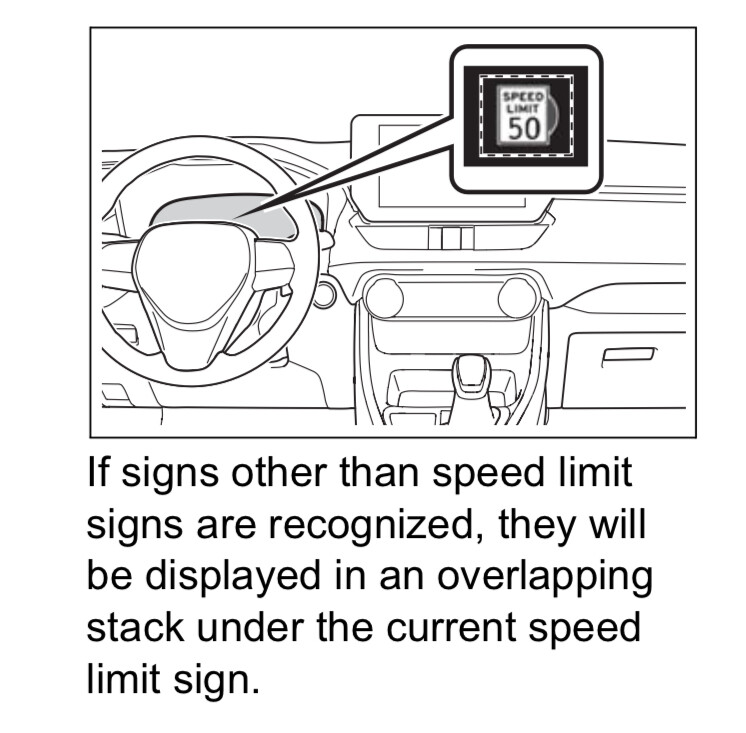

The car has CarPlay, but this is for the dashboard.
The system that you describe was first introduced by Euro NCAP more than 10 years ago and has been common on vehicles with a 5-star safety rating in Europe, Australia and New Zealand. The recent EU regulations are similar.
As stated in the 2017 report that I refer to above, the main issues have been the accuracy of speed limit mapping and camera recognition of speed limit signs. Unfortunately these issues have not been satisfactorily addressed by vehicle manufacturers and road authorities.
There are remarkable road safety benefits from reducing low-range speeding - see the report for details.
2 Likes