Shiny doodads for the unwashed masses.
1 Like
A step backwards in usability IS worse—by definition.
2 Likes
I hope Apple gets its acts together especially with its recent executive news. Lots of bad decisions these days. QA is bad too. There are reasons why I never get the latest verisons because I don’t care for the new features. I just want fixes especially security. I am not touching its v26 when I can (Apple is nagging me to upgrade macOS and iOS daily – NO! LEAVE ME ALONE! I WILL UPGRADE WHEN READY!).
the nagging is especially pernicious when you’re very clear that their so-called upgrade is absolutely undesirable.
1 Like
I am sure v26.2 will be the first version that supported iPhones that will have to get for security fixes after v18.7.2. It might be tomorrow. Ugh.:(
The only thing I don’t like is the transparency of pop-up and pop-down menus and worse that they take on colors based on what’s behind them. (This is on an iMac)
V26.2 are out now. No v18.7.3 for my old iPhone 12 mini since it can run iOS v26. I am going to wait a bit to be sure it is better. I don’t have time to deal with issues from it right now. Maybe during Christmas week.
You’re not the only one who dislikes Liquid Glass. I’m (unfortunately) on 26 with my iPad and iPhone, but I’ll be staying with Sequoia on my Macs for as long as possible.
1 Like
Yeah, I avoid the newest version when I can. I upgraded 13" 2020 Intel MBP’s Ventura to Sequoia a couple months ago. Even Sequoia still has some minor issues. Ugh.
This is the inevitable result of Apple’s invariable yearly upgrade cycle. Every new version of the OS is released at the appointed time whether it is ready or not. Some of the remaining bugs will be fixed in future updates, and others will never be fixed. Over time, the number of unfixed bugs that are passed on from one OS version to the next inevitably grows. It would be very foolish to believe that such a development cycle doesn’t lead to product degradation. The simple truth is that Apple’s yearly upgrade cycle is driven by marketing considerations, not their commitment to quality.
1 Like
Yeah. I really wished Apple go back to its old days. They were so much better.
Speaking as someone who has been writing about what does and doesn’t work, I don’t think much has changed in a notable way. The larger the feature changes, the more likely it is to take several point releases before things settle down. Sandboxing, APFS, 64-bit transition, and Apple Silicon all took some time to become solid. Liquid Glass is definitely one of those, although most of its issues are cosmetic.
It’s certainly true that Apple moved to a standard Q3 release in 2013 with Mavericks, but releases before then often occurred on a roughly annual schedule. It was really only longer than that for the five releases from Panther through Lion. From Wikipedia:
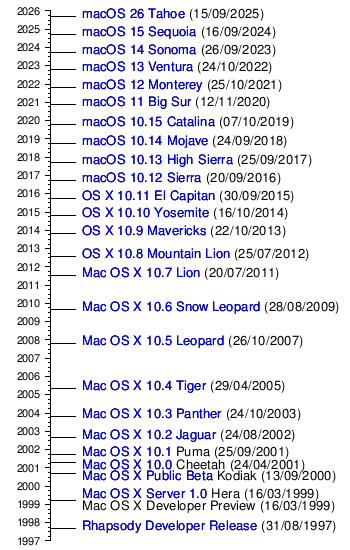
And while Apple has put itself on an annual schedule, and part of the reason is for “marketing” reasons (a necessary fact for an organization that depends on selling things), it’s also just sensible. Apple has seven separate operating systems (macOS, iOS, iPadOS, watchOS, tvOS, visionOS, and HomePod Software) that share core code and numerous interoperability features, and seven distinct physical product lines that require regular releases to remain competitive. No organization will agree to a completely unpredictable release schedule that has so many connected ramifications.
Establishing and sticking to a schedule creates a predictable work schedule with clear goals for everyone at Apple, from developers to marketing to Apple Stores.
5 Likes
There was a time when most software was upgraded when an upgrade was ready for release. There was no fixed schedule and no market pressure to create one. Modern corporate culture has created this conveyor belt model and sold it to consumers, but there is nothing inevitable about it. Personally, I am not convinced that that it isn’t highly dysfunctional rather than innovative.
I don’t disagree, I’m just not convinced a yearly schedule is the correct target.
I’d understand more if these were paid updates, where the company wanted a steady flow of income, but a ‘major’ update each year results in questionable new features accompanied by inevitably buggy releases. I don’t see annual updates as a valid reason to update hardware, so I question the wisdom.
There’s nothing to stop Apple (or anyone else) from adding smaller changes on top of a stable release, whilst extensively testing larger features for quality major releases.
The current philosophy seems like a race to the bottom. I’m consistently frustrated playing whack-a-mole with hidden GUI etc when what I really want is for Siri to understand some very basic commands.
4 Likes
To me, that feels like an artisanal approach to software, which was certainly more true 25 or especially 30 years ago, but that was only possible in a small, slow-moving market. Over the last 15 years at least, the tech world has become industrial in nature, with all the good and ill that comes with such a transition.
In 2000, estimates suggest Apple was selling 4–5 million Macs per year. On the Mac side alone, Apple now sells 20–25 million per year and nearly 400 million devices total between the iPhone, iPad, Mac, Apple Watch, and Apple TV. Even assuming the old strategies were intentional at the time and weren’t merely organic, there’s no way they could support a 90x scaling in the business across multiple product lines.
2 Likes
You’re probably right about that. I just can’t help missing the world the way it was back then–maybe just as crazy, but not so obviously so. Nowadays, everybody’s got their foot to the floor about everything, and it feels like what we call “progress” is really a race toward the Abyss.
2 Likes
The other key difference between now and 25-30 years ago is the complete elimination of physical media. In that era, to release an update of any scale was a major undertaking – if it was free to the user, it was expensive for the vendor; if it was a paid upgrade, it had add features that were worth the price.
Now, updates are quickly and easily downloaded, so it’s easy to quickly deploy small updates and make sure all users get them.
I would compare it to typing. Midway through my one-semester high school typing class, all the old manual typewriters were replaced with electronic ones, which had reliable correction tape. With a classic manual typewriter, any attempt at correction was very slow–meaning that the optimum approach was to focus first and foremost on 100% accuracy and only develop enough speed to be consistent with maintaining that accuracy. When small, quick corrections were possible from the keyboard, the optimum shifted a bit towards compromising accuracy a bit to gain speed. And obviously once you’re on a computer, it shifts a whole lot in the other direction since anything can be easily fixed. While it would probably make smoke come out of my typing teacher’s ears to admit it–she really didn’t want us to use the correction tape–a reduced cost of making corrections definitely means that the overall best strategy is not the one that is 100% focused on first-time accuracy.
The same, I think, is true of software development. If small bugs are cheap to fix, then it doesn’t make sense to devote vast amounts of time and effort to track them down and eliminate them in advance.
Dave
5 Likes
The flaw in this argument is that the small bugs have always been cheaper to ignore, as their effect on users is minor and they don’t reduce sales in any traceable fashion. At no point in time has it been cost-effective to fix small bugs, either before or after release. A developer has to place a non-monetary value on being maximally bug-free, and large companies simply don’t care enough to do that.
2 Likes
I completely agree, @omalansky !
I think Liquid Glass is a step in the wrong direction. In contrast, the liquid-based theme I do like is Aqua.
I’d welcome that back in a heartbeat. There was a lot less hide-and-seek to be played with the user interface in those days. And it wasn’t flat.
1 Like
Loved Aqua theme. So pretty and tasty. ;)
2 Likes