How Planning Made My Second Long EV Trip Stress-Free

Originally published at: How Planning Made My Second Long EV Trip Stress-Free - TidBITS

Back in April, I took my first long trip in our Hyundai IONIQ 5; see “My First 700-Mile EV Road Trip—What Worked and What I’d Change,” 24 April 2026. Working through what I needed to do and seeing how well it worked was eye-opening, and I enjoyed the lengthy discussion in the comments. Given how well things went during the trip—there was only one unplanned stop caused by poor preparation—I was surprised how many commenters took the story as evidence against ever buying an electric vehicle.

A few weeks ago, Tonya and I took our second long trip in the IONIQ 5, driving from Ithaca to Boston for her niece’s bat mitzvah and to see longtime industry friends in person. It’s a roughly 300-mile drive each way, plus we had a fair amount of driving around between venues while we were there. Given the IONIQ 5’s advertised range of 269 miles, we were looking at three charging stops for the weekend.

Pre-Trip ABRP Setup

For this trip, I made a few changes. First and most importantly, I subscribed to the premium version of A Better Route Planner (ABRP). Although the free version worked acceptably during my first trip, I realized that several premium features would be helpful. Prominent among those were CarPlay support, which would allow A Better Route Planner to display mapping and navigation instructions on the IONIQ 5’s screen, real-time live data from the car, live weather data for planning, and real-time traffic awareness for planning. The premium plan can also supposedly record every drive, and while it correctly captured most of the data on the longer portions of the trip that included charging stops, its data on other days was often incorrect or missing (note the straight line in the middle 06-20-2026 screenshot, and how the route incorrectly ends in Albany in the right-hand 06-21-2026 screenshot; we did make it home).
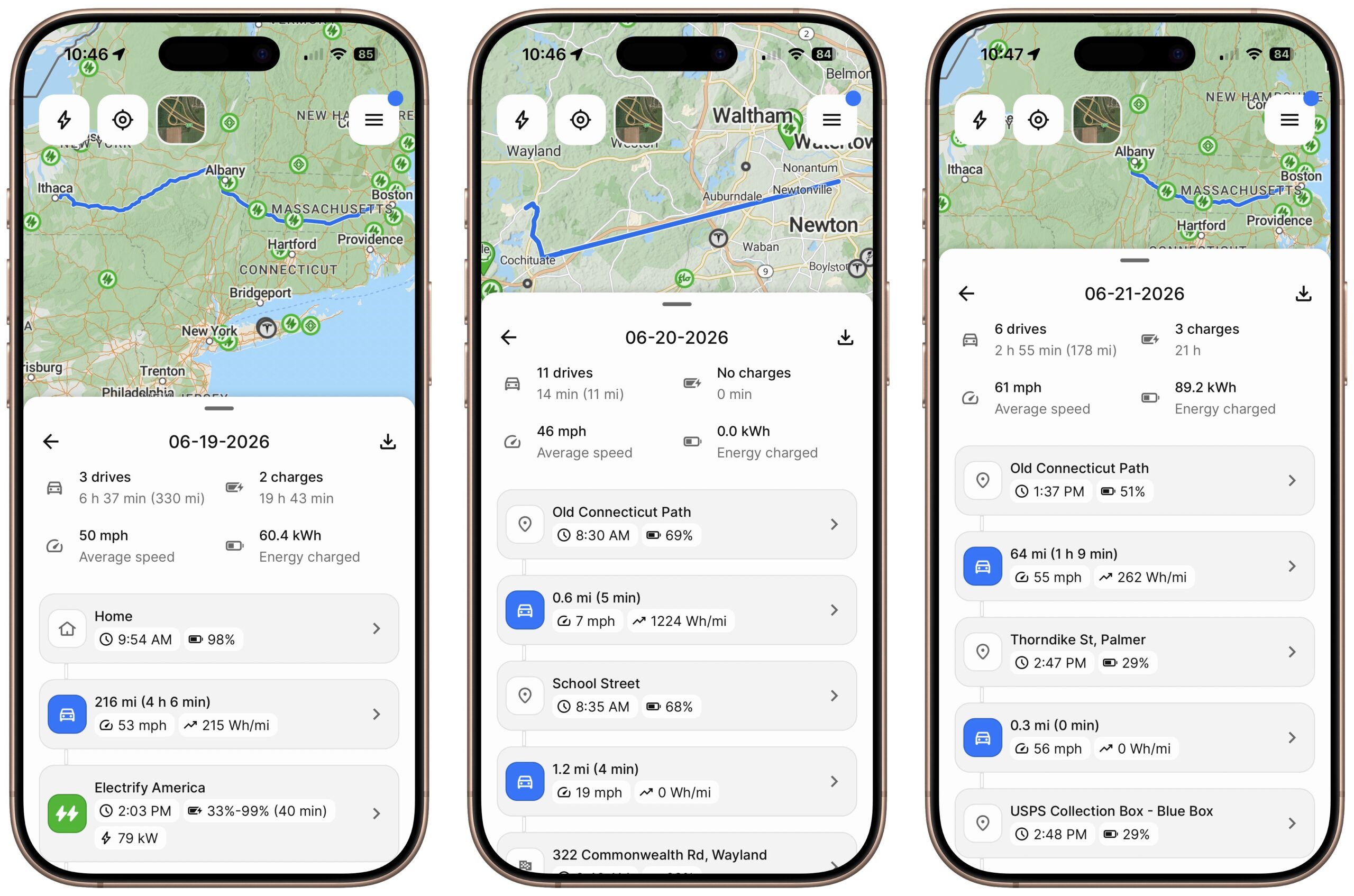
A Better Route Planner drive history

ABRP’s CarPlay support was helpful because it enabled me to use ABRP’s route planning for navigation, rather than having to transfer destinations to Apple’s Maps. Plus, the CarPlay app displayed ABRP’s estimate of how much charge we’d have at each stop, so I didn’t have to do any calculations to compare remaining distance to remaining charge.

I strongly suspect ABRP is using the Maps API, since it looked and worked a lot like Maps. It was fine, but it didn’t seem to do as good a job as Maps at providing contextual instructions (“go through this intersection and at the next stop sign, turn left”), and although you can download additional voices (in Settings > Accessibility > Read & Speak > Voices), ABRP accepted only US English voices for me, not the Australian voices I prefer to smooth over voice synthesis quirks.

To help ABRP provide accurate range estimates, I connected the ABRP app to the IONIQ 5 in two ways. First was the Enode API, which allowed ABRP to access data from Hyundai’s Bluelink service (essentially the same data as what the MyHyundai app receives). Second, after hearing my discussion about the trip with Allison Sheridan on her CCATP #834 podcast, one of her listeners kindly sent me a Veepeak OBDCheck BLE scanner he no longer needed. Although ABRP doesn’t recommend that particular model, it seemed to work for me. Keep in mind that OBD scanners can pose a security risk, and some will drain the 12V battery if left connected indefinitely. Some research would be necessary to find a secure one that won’t draw power while not in use.
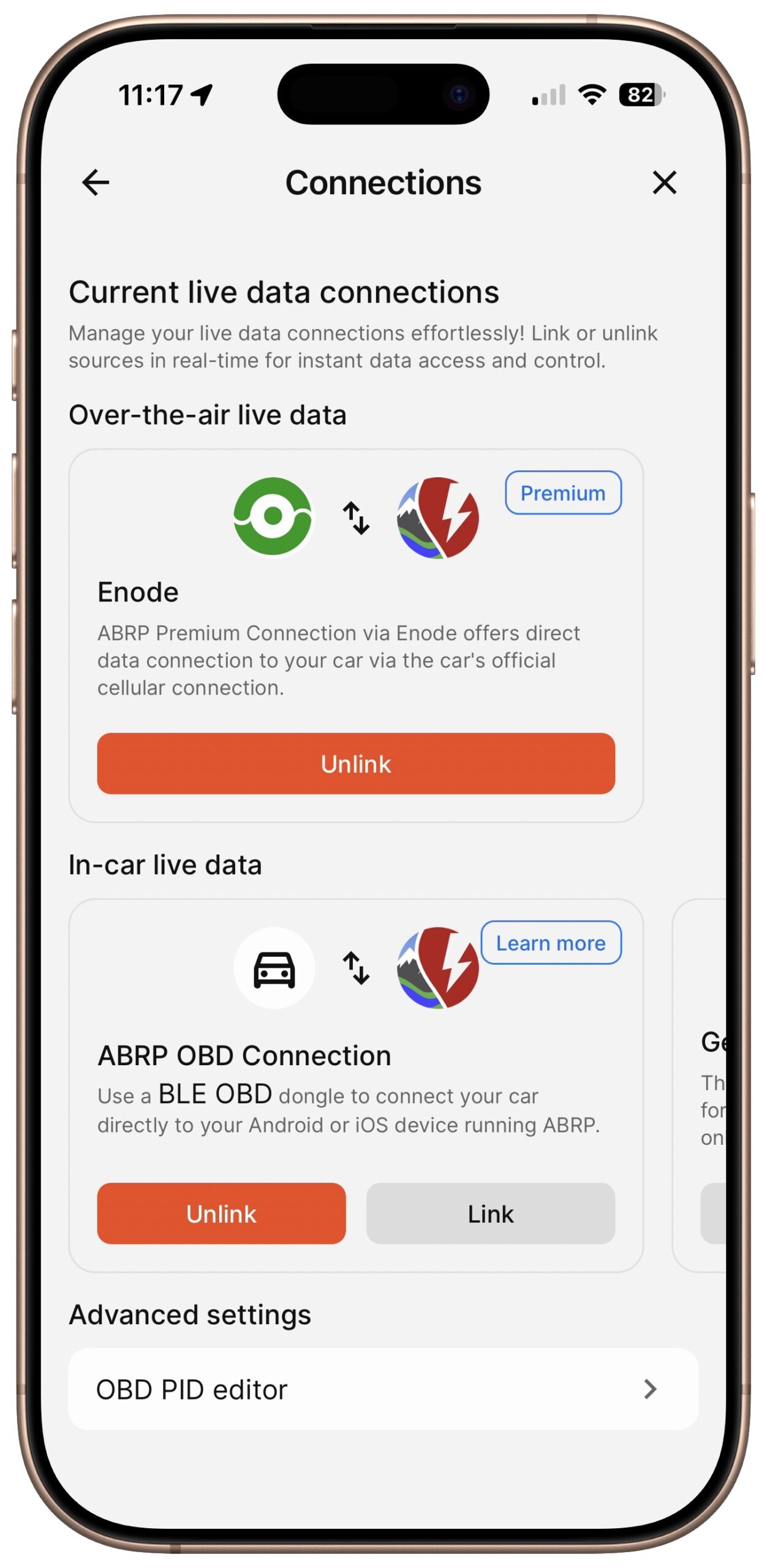
A Better Route Planner live data options

Neither the live weather data nor the real-time traffic data seemed to affect our trip. The weather was pleasantly warm and sunny the entire weekend, and since our charging stops were right off Interstate 90 each time, traffic was never an issue.

Route Planning

With ABRP better set up, I turned my attention to the trip planning. I realized it would be smart to plan the full round trip rather than treat it as two one-way trips. That would reduce the chance of being surprised by a low battery when we were ready to drive home. In reality, because we were in a major metropolitan area, we were never more than 5 or 10 miles from a high-speed charger, so ad hoc charging wouldn’t have been a problem. But I didn’t want to leave anything to chance.

There were a few minor hiccups in this strategy. First, I was planning a three‑day weekend, but ABRP assumed I was doing it all at once, which led to some very weird arrival times. I could imagine the algorithm making less‑than‑optimal choices based on those arrival times as well, so once it suggested charging stops that seemed reasonable (and had nearby backups), I hard‑coded those into the trip stops.

Second, we had a few hours to kill between the bat mitzvah service and an evening picnic, so Tonya and I decided on the spur of the moment to visit the deCordova Sculpture Park (highly recommended!), which added some unanticipated mileage, though not enough to upset any estimates. Slower city driving takes longer, but it usually consumes less power than fast highway miles.

Third, I had planned to arrive at our friend’s house—where we were staying overnight—with a 60% charge. (We could have plugged in there, but 110V charging speeds add only about 1% per hour, so we didn’t want to depend on that.) That provided plenty of buffer for the trips the next day, and when it came time to leave on the final day, it didn’t seem to make sense to stop for the first of our two necessary charges right away, as I had initially planned. So I let ABRP replan the trip home, and it picked two different charging stations to split up the trip more evenly.

Because we were going to have to charge at least three times no matter what, I set relatively high arrival charge levels to eliminate any stress about whether we’d be arriving at a charger with a low battery. ABRP reports on charger status, but even if one had just failed, we could easily have gotten to another one with the 30% or more charge we had remaining.

The final tweak I made, partly to increase buffers, was to charge to 80–100% at each stop. ABRP doesn’t recommend this by default because charging is fastest in the 10–60% range, after which it slows down. That biases ABRP’s routing toward more frequent, shorter stops, whereas I prefer stopping less often for longer. Because the IONIQ 5 charges particularly quickly in its sweet spot, filling it up beyond that seemed to add only 10–15 minutes, which was less than another stop. Vehicles that charge more slowly may lead to different trade-offs.

Driving and Charging

As on my first trip, I chose to drive in Eco mode with Level 3 regenerative braking, and I set the cruise control to follow the speed limit (or the car ahead of me) nearly all the time. That may have surprised ABRP: it often estimated an arrival at 30% state of charge, but we’d reach the stop at about 36%. I can’t complain about cautious estimates, though they were consistently low enough that I could have reduced my arrival buffers without worry.

As it worked out, our first charging stop was at an Electrify America station at an outlet mall. It took so little time that we barely had time to eat a quick lunch before we had to unplug and move the car so we wouldn’t be charged for idle time while attempting some audibly painful and entirely fruitless shopping. I had used Electrify America stations on my previous trip, so I was familiar with the app.

The second charging stop, however, was at a Tesla Supercharger. Because our 2026 IONIQ 5 has the Tesla NACS port, it was no problem to plug in and start charging. Owners of cars without a native NACS port will need support from Tesla and a NACS adapter. As you might expect from Tesla, the only way to start and pay for charging was with the Tesla app, which I had previously downloaded and configured. It was a little confusing because it’s the same app Tesla drivers and Powerwall owners use, but once I set it up, it offered a straightforward charging flow for non-Tesla owners (below left).

The third stop was another new-to-me charging network, EVgo. It would have allowed me to pay with a credit card, but since I didn’t know that, I had already downloaded and configured the EVgo app. ABRP (below center) reported on the charging progress in lockstep with the EVgo app (below right).
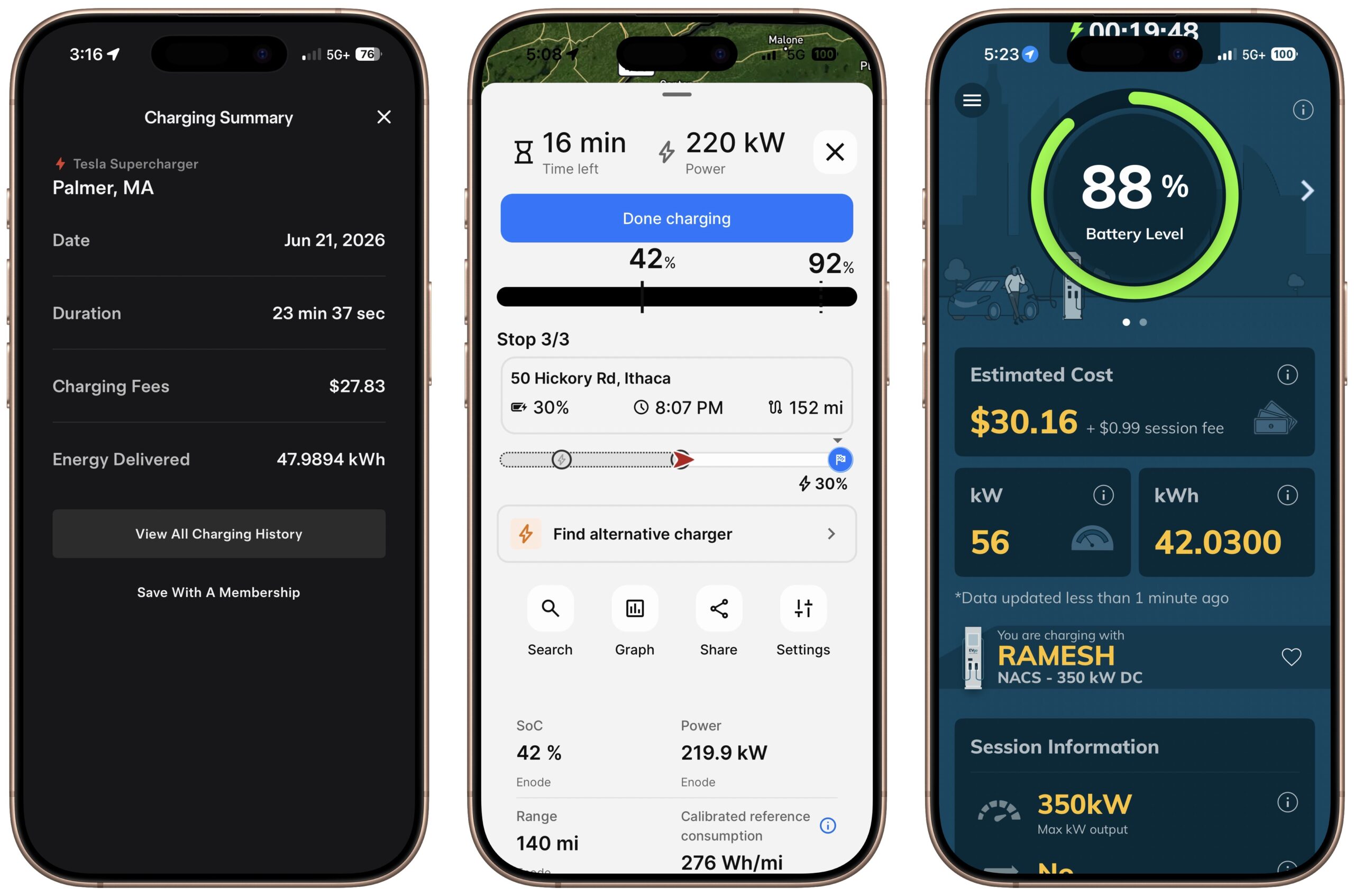
Tesla, ABRP, and EVgo apps during charging

Pricing for the stops varied. Electrify America charged $0.64/kWh, Tesla charged $0.58/kWh, and EVgo charged $0.72/kWh. Those prices were higher than the $0.48–$0.56/kWh I paid on the previous trip, perhaps due to tax differences between Pennsylvania, New York, and Massachusetts, or seasonal pricing. Regardless, none of the bills felt extravagant.

Takeaways

Overall, planning the full round trip in ABRP, setting generous arrival buffers, and charging to 80–100% kept the weekend stress‑free. Charging itself was essentially boring. Our two stops on the way home didn’t correspond with meals, so we walked around two outdoor malls that had nothing of interest beyond bathrooms. We liked stretching our legs during the long drive, but if it had been dark, we probably would have stayed in the car—the malls didn’t feel like the best places to linger after hours. Although ABRP does list amenities near each charging station, you can’t really tell if it’s a nice area or not, and the charging stations do tend to be on the edges of shopping plazas.

We have another summer trip to Vermont planned for a family wedding in August, so it will be interesting to see if this approach holds during that trip as well. For the moment, though, I’m extremely happy with how easy and stress-free the process was. It did require more planning than I would have done for a road trip with our gas-powered Subaru Outback, but it wasn’t that long ago that gas stations—particularly those with 24/7 pay-at-the-pump systems—were far from ubiquitous. I remember some extremely stressful moments when we were low on gas in an underserved rural area or late at night when many gas stations were closed. I’m happy to trade that stress for some advance planning in an easy-to-use iPhone app.

3 Likes

Thanks for sharing experiences in these posts, Adam. You don’t just recommend CarPlay apps, but relate some tricks and tips for using them. I have an OBD for the gasoline car but had not considered one for the EV. Details, such as comparison of 4 different public charger rates ($0.64/kWh, $0.58/kWh, $0.72/kWh, $0.48–$0.56/kWh) help a lot.

I spend 11¢ per mile (EV) vs. 25¢ per mile (ICE).

YMMV — literally — according to your power company’s rates, solar panels, pump prices, etc. Howsomever, here is how I arrived at my numbers.

  • For a good sample size, I waited until my EX30 turned 5,000 miles.
  • I have yet to visit a public charging station!
  • During off-peak hours (12AM-3PM) PG&E charges me $0.225/kWh.
  • Your on-the-road prices (average $0.58/kWh) still work out to half the expense of gasoline.
  • I even used a ridiculous $5/gallon to give the internal combustion side of the equation a break.

(Have you considered launching an EVBITS site in your spare time?)

1 Like

After sharing your first trip Adam, I decided to share mine on Facebook. Here is my feedback

We just completed our first extended trip in our EV. I’d like to share some tips for other EV owners, and get your opinions.

Get the app A Better Route Planner (ABRP). You give it your source, destination, and any stop you want and it determines the best route. You pre-define it with your car (model), starting charge, desired arrival charge level, your favorite charger brands (think gas stations), etc. It figures out your best route to get where you are going. I also select a bathroom nearby and also a food stop if possible. I always start with a 100% charge and like to arrive about a 40% charge. ABRP then calculates you stop here for 13 minutes, there for 22 minutes, another one there for 17 minutes and you end up at your location with 43% charge remaining.

However, I don’t like ABRP’s actual route guidance. It is to (voice) chatty for me while driving. But each stop has an address so I put that address into Apple Maps (Google Maps, Waze, whatever) and Apple Maps is more knowledgable about traffic delays, best routes, etc. Same destination (kind of - more in a minute) and for me less voice chatty.

Same destination, not really. Maps gets you to the address. However I’m sometimes dropped off at the street address, not the final maze in the parking lot to the front of the store. But even that isn’t good enough. This is where ABRP comes back to life. ABRP’s destination is the lat/long of the actual charging station which is usually in some far corner of the parking lot. No looking around to find it at the mall.

ABRP is NOT using Apple’s maps API. We passed 2 exits that were completely closed. ABRP had no idea. Finally the 3rd exit after our stop was open and we had to double back about 5 miles.

ABRP is free but you can get a paid version. I paid for 1 month while I took this trip. It gives you additional features but honestly I don’t think I needed or used any of them. I do want to support the developer so I’ll see what future trips require.

One thing I (we) would like is the ability to say something like find me a DQ (Dairy Queen) along the route as well. That feature doesn’t exist on either ABRP or Maps that I know of yet. So we sill watch for DQ signs and venture off the route on our own at times.

You also still need the charging stations app to use and pay for the electricity. I probably have a dozen now. Electrify America, ChargePoint, EVgo, Tesla (no I don’t have a Tesla but I have a Tesla charger adapter), Shell, Blink, etc. A couple of stations supposedly will simply take a credit card, but I found the app more reliable than a simple credit card.

Ed

I am also going to add that I created a fun little EV vs. gas comparison calculator: EV vs Gas: Cost-per-Distance Calculator

What is the mileage of your gas car? My Honda Civic averages about 35 MPG. At current (Costco, Virginia) gas prices of $3.70/gal, that comes to about $0.11 per mile.

Even under my worst driving conditions, I get about 25 MPG. At today’s California prices of $5.40/gal, that still comes to only $0.22/mi.

So you’ve apparently got both an inefficient gas car and very high gas prices where you live.

I wish I could say that.
If I look at my PG&E bill, generation is indeed only 14.5¢/kWh (AVA 100% renewable), but that’s also only about one third of the picture. They also charge me for delivery, and that’s at a whopping 25.49¢/kWh, at least for our typical use.
So in total, my real cost for electrical power at home (time-averaged) is closer to $0.4/kWh.
Of course even my highly efficient Prius c ends up at about at 11¢/mi with current high gas prices (thanks to another forever war of which we were no longer supposed to have any) so as long as an EV gets >3.6 miles/kWh it would come out ahead in terms of just fuel cost.

The electricity base charge, delivery charge and (whatever) fees are there even if I don’t own an EV. So my EV cost really adds only 22.5¢ per kWh. Moreover, EV rate plans reduce other power costs.

It would take a week to consider all the variables — 20mpg vs. 35mpg, lifetime maintenance expense, efficiency of this EV vs. that EV, the price at the pump in Alaska vs. Louisiana, outdoor temperature, rebates, etc. In the end, all the calculations converge on a cost-per-mile that is half that of a gasoline burner. There are valid reasons for clinging to internal combustion, but ROI is not one of them. Besides, gamers would miss all that fun with ABRP.

For me they are per KWh, so the more power I use, the more I pay for both. That’s in two homes, for one it’s currently $0.375/KWh and the summer house is currently $0.30/KWh. Since we have a plug-in hybrid and the battery isn’t that large, we don’t have a 220V charger connected, yet, but we are adding one in the summer house and I think I can get a discount if I schedule charging when it’s not peak time, but I’ll look into that more when the charger is actually connected next month.

1 Like

Adam, that’s great you had a smooth EV road trip, and I expect that will be the norm. Several charge networks are connected so you can use one’s app with another network. ChargePoint and EVGo do, and apparently Electrify America interoperates with both of those, although I’d never heard that from EA in 3 years of membership. Using an app (or nicer, Apple Wallet card) from a network avoids worrying about credit card skimmers. I’ve seen some reports that skimmers are found on EV chargers, which seems plausible as they are completely unattended.

Network monthly membership fees tend to be rather low - you might save on total charging cost on a single long trip.

1 Like

All these planning apps seem helpful, but do any of them take into consideration the value of your personal time lost waiting around for a charge to complete? I can be in and out of a stop at McDonalds to eat in under 15 minutes, even less for a gas fill up or bathroom break.

Or is “time is of the essence“ no longer part of EV travel?

1 Like

If I’m driving up to 6 hours, which is about the most my body can handle in a day, an extra 15-20 minutes here and there is immaterial—most of the day is lost to travel regardless. If time were of the essence, I could:

  • Drive as fast as possible and hope I don’t get caught or cause an accident
  • Reduce bathroom stops to the absolute minimum
  • Skip eating, or bring food to avoid stopping (but that would delay leaving)
  • Endure significant discomfort and outright pain from sitting for hours on end

Or I could just plan to leave at the appropriate time and include longer stops with food and charging so the trip is as enjoyable as possible within the bounds of sitting in a car for that long. For us, that involves stopping whenever Tonya or I need to use the bathroom rather than enduring the stress, trying to find decent food, and doing some actual walking whenever we do stop to keep our legs comfortable.

And of course, given modern iPhones and MacBooks, we could just work in the car while charging if we wanted.

1 Like

I’ve had a Mustang Mach-e for 5 ½ years now, back before we could use the Tesla network. I took my first long trip in the fall from SoCal to DFW area and back, 4 days, 3 nights each way. At times it was worrisome trying to find a working charger, more than once I had to leave and not only go to another charger, but a completely different stop. Other times, I’d have to wait in line since it was the only charging stop for many miles. The best stop was a set of charging stations at the stalls of a Sonic Burger in Texas. Pulled in, plugged in, ordered and ate while charging. But since then, I’ve not worried about it. The charging situation has gotten exponentially better with Tesla charger access and now I just drive like I would with an ICE vehicle. I generally know where to stop and charge. Going to Las Vegas I still stop at the Jack-in-the-Box in Yermo like I did before, but now I eat at the charger up the road instead of while driving.

The one thing I do try to do is find a hotel with a charger. Outside of San Antonio, there was a set of EA chargers in the parking lot. In Visalia, I booked a hotel with L2 chargers and just let the car charge all night. No idle fees. Start the day at 100%.

Never going back to ICE again.

Basically, just follow the advice of The HitchHiker’s Guide To The Galaxy, Don’t Panic.

image

This is supposed to be an animated GIF that flashes - it no longer works with iOS :face_with_raised_eyebrow:
I created it for a Y2K webpage

As I have mentioned in the previous discussion, I find a plug-in-hybrid very useful in Australia. Most of my city driving is pure electric and the petrol (gasoline) engine is for long journeys, especially when towing a caravan.

1 Like

FYI, the animation works for me. I’m using the Discourse hub app on an iPhone.

It displayed properly in iOS Mail for me.

Just used ABRP to plan and complete a ~800+ mile round trip route. Latest iOS in iPhone 13 mini and 16 Pro, 2024 Ford Mustang MACH-E with latest software updates.

The app was very helpful at determining where to make stops at High Speed (we used Rivian and Tesla) chargers along the same route that Apple Maps and Google Maps had proposed. Planned stops worked without a hitch. We didn’t bother to monitor time on charger to limit it to what the app proposed. We just did what we were doing, mostly eating what we’d brought along, and moved on when we were done. Our time on charger was always more than the app suggested. We weren’t trying to be as economical as possible.

I signed up for Premium to be able to ‘share’ ABRP’s route with Apple Maps in CarPlay but couldn’t get it to work. With a bit of futzing around we did get the route shared with Google Maps in CarPlay and used that. I submitted feedback about the Apple Maps fail. We’ll see if that’s a problem local to my setup or if they’ll be able to do something to make it work. In any case I cancelled my Premium level before having to pay for it.

Overall I would highly recommend using ABRP for EV trips. (Not sure if it’s mentioned elsewhere here, but apparently they were bought by Rivian, probably to give Rivian something equivalent to the route planning/charger locating software in Teslas.)

Speaking of driving in Boston, once (a long time ago) I rented a car at Boston Logan Airport. I asked the person at the counter for a map. She handed me a map of Boston and said, “Here. But it’s not going to help.”

3 Likes

Yeah. I had the unfortunate business trip that involved driving in Boston. You really do need GPS to get around that city. Fortunately, I always travel with a vent-mount for my phone.

Boston is the only city I’ve been to where two one-way streets terminate at the same place on a cross-street.

I’m really surprised the entire city hasn’t devolved into one giant million-car collision.

1 Like

Ah - because I have Accessibilty/Motion/Reduce Motion turned on in my iPad settings
:grimacing:

1 Like

I’ve owned a 2025 IONIQ 5 since last October. I have excess solar on my house and a level 2 charger at home so I’ve never used a paid charger until two weeks ago when we drove from Long Island to Hunter, NY to Toronto after an overnight stop and then to Orillia, ONT after an overnight stop and then back to Toronto and then back home to Long Island after the weekend. It was my first experience with paid fast charging, and it was pretty stress free. I have an ODB connected to ABRP and paid for the premium version for the month so it would display with CarPlay, although there were times I went back and forth to Apple maps. I found the best way to use ABRP was to plan in segments, rather than the full trip or even a full days drive. I’d use PlugShare to verify details about the chargers that ABRP suggested, and sometimes PlugShare showed more chargers than ABRP. I was able to use Tesla superchargers through Hyundai Pay in the US with no problem, but Bluelink and Hyundai Pay in Canada don’t share enough information with Hyundai US to make that work, so I had to use the Tesla app in Canada. I did use and preferred a number of other vendors chargers, and some of those using the CCS adaptor that came with the car were even faster than the Tesla superchargers. If I had to connect first I could usually start charging through Hyundai Pay. If I had to pay first I had to use that vendors app or my charge card. In any case, there was never any issue and I found it easy to find chargers when and where I needed them. I never charged during any overnight stays, but would charge up at a fast charger before stopping for the night. Having previously owned a Bolt, the fast charging on the IONIQ 5 was impressive and made me much more comfortable with using it for very long drives rather than taking my older hybrid Prius.