Originally published at: Apple Unfolds the iPhone Duo - TidBITS
Everyone expected a folding iPhone from Apple’s “Surprise and Shine” event, but before new CEO John Ternus started the unveiling with the classic Steve Jobs callback of “one more thing,” it was hard to imagine exactly what the iPhone Duo would look like. (Amusingly, Ternus concluded the presentation with a phrase straight from the mouth of Tim Cook: “I couldn’t be more proud of the teams across Apple who made today possible.”)
Now we know. First, the basics: the iPhone Duo will start at $1999 in Star White or Night Sky and open for pre-orders on 16 October 2026, with availability starting 23 October 2026. Apple said the iPhone Duo will ship with iOS 27.1, so it will likely appear that week, too.

Industrial Design
Rather than jam two iPhones together along their long sides, Apple redefined the iPhone form factor so it’s smaller when closed and provides a wide-screen viewing experience when open. The closest familiar analogy is to a passport booklet.

At 5.2 mm thick when opened, the iPhone Duo is Apple’s thinnest iPhone—the iPhone Air is 5.64 mm. However, when closed, it’s 11.3 mm thick—more than any iPhone since the 12.3 mm iPhone 3GS. Recent iPhones run 8–9 mm thick, and none of these measurements include camera bumps, which add another 4–5 mm. Of course, that’s all before adding a protective case, which makes any iPhone noticeably bulkier. It also weighs 254 grams, slightly heavier than the 249-gram iPhone 18 Pro Max, and much more than the iPhone Air (165 g) or even the iPhone 17 (177 g).
To make the iPhone Duo useful as soon as you pull it out of your pocket or bag, it has a 5.4-inch screen on the outside that provides 90% of the screen area of the 6.3-inch iPhone 18 Pro, and when you open it, you get a 7.6-inch inner screen, just slightly smaller than the 8.3-inch iPad mini. The aspect ratio is the same on both screens, so content can scale proportionally as you move from the outer screen to the inner one. The inner display also has a matte nano-texture finish that Apple says reduces reflections and makes the crease less visible.
With the Home Screen in particular, that means that what you see on the outside fades out as you open, fading in on the right side of the inner screen. The left side displays Today View, iOS’s scrolling list of widgets, though you can swipe left for additional full-width Home Screens. Apple’s intro video does a good job of showing how you’d use it, though it’s also worth watching event videos from Joanna Stern and Nilay Patel.
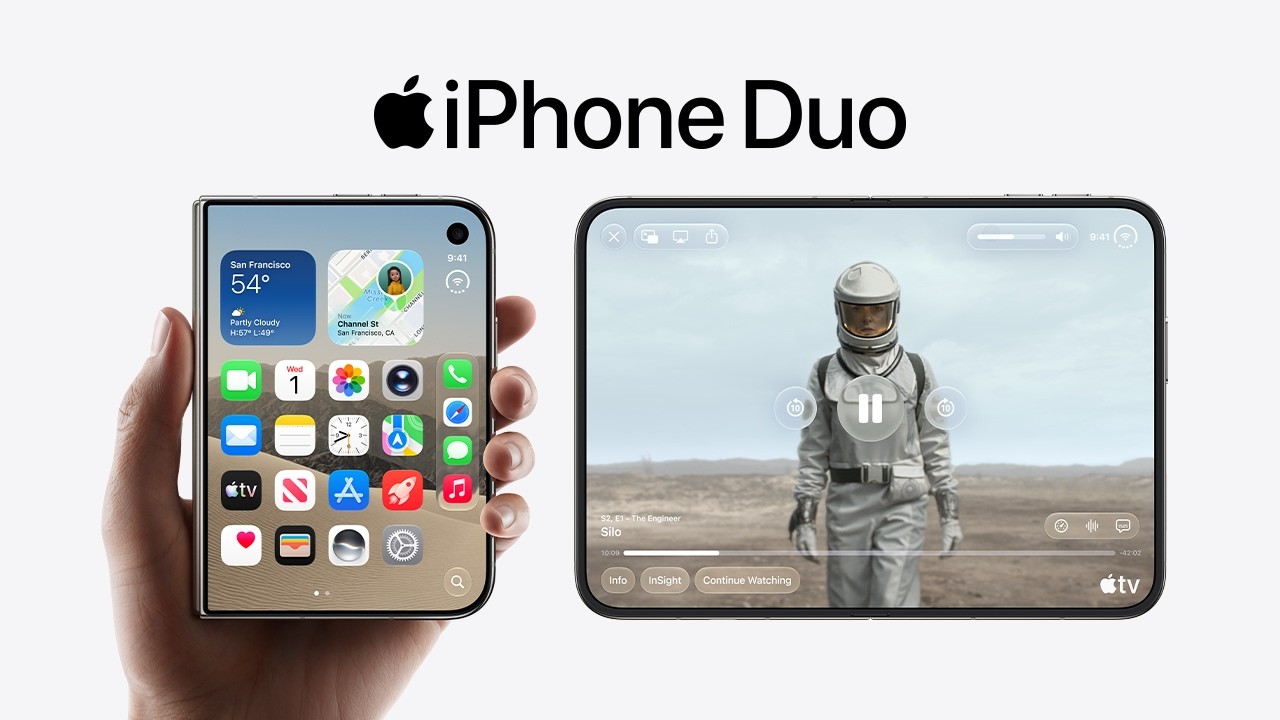
During the announcement, Apple spent significant time talking lovingly about the engineering that went into the iPhone Duo, from the more than 100 components that went into making the hinge feel satisfying and secure, to the multilayer lamination design for the inner screen, which features custom adhesives that allow the layers to glide relative to one another so the crease doesn’t distort over time. It even maintains an IP68 water resistance rating, like the iPhone 18 Pro, which in this case means immersion up to 6 meters for 30 minutes. I suspect Apple has done a good job with the hardware, since the company’s engineers have had several years to watch the mistakes made by the likes of Samsung, Google, Huawei, and Xiaomi with their foldable Android phones. But we’ll see!
The most notable hardware compromise in the iPhone Duo is that Apple punted on Face ID, instead embedding Touch ID in the side button, though Apple Watch users can also unlock it from their wrists. Perhaps the way you hold the iPhone Duo will make Touch ID less annoying than it is on the iPad Air, where I use the passcode most of the time because Touch ID requires putting my finger somewhere it doesn’t naturally want to go.
Also missing is the Action button, which some people will miss, though the Camera Control retains its spot beneath the side button. MagSafe is present.
The iPhone Duo relies on the same A20 Pro chip as the iPhone 18 Pro, so performance should be top-notch. Apple splits the battery between the Duo’s two halves and claims up to 24 hours of typical mixed-display use.

Cameras and Photography
The iPhone Duo has two front cameras: a 12-megapixel Center Stage camera on the outer screen that’s always visible in the upper-right corner, and a FaceTime camera on the inner screen that hides underneath the display unless it’s actively in use. Apple’s tech specs for the iPhone Duo conspicuously don’t mention the resolution of the inner FaceTime camera, saying only that it produces 1080p video, far less than the 4K from the outer Center Stage camera. It seems safe to say that you’ll want to rely on the outer Center Stage camera for selfies.
The rear camera array echoes what Apple did with the iPhone 17’s dual-camera system, offering a 48-megapixel Main camera and a 48-megapixel Ultra Wide, the latter of which matches the iPhone 18 Pro. Notably missing is the iPhone 18 Pro’s 48-megapixel Telephoto camera. However, the iPhone Duo improves on the iPhone 17 video pipeline, with its Main camera supporting 4K Dolby Vision at 100 and 120 frames per second.
More interesting are the ways Apple leverages the iPhone Duo’s folding form for different camera experiences:
- Smart Take uses on-device AI to capture photos automatically while subjects are posing.
- Duo Preview shows a live preview on the outer display so subjects can guide the shot.
- Kid Cue plays Peanuts animations to grab children’s attention.
- Duo FaceTime lets people who are with the user join a video call on the outer display.
Rethinking iOS
Given that the iPhone Duo’s 7.6-inch inner display approaches the 8.3-inch iPad mini in size, you would be forgiven for wondering whether it’s essentially running iPadOS. The answer is no: it runs iOS 27, extensively adapted for the Duo and borrowing Split View multitasking from the iPad. (At Six Colors, Dan Moren has a whole column on why you shouldn’t call it an iPad. But Apple says it will support the Apple Pencil later this year.) Since I rarely use the iPad and never use Split View beyond testing, I can’t comment on how complete it is. From the videos, you can easily bring up two apps on either side of the inner display, adjust the size of each, drag content between them, and open two windows in apps like Safari.
More significant are the system-wide changes. With vertical space at a premium, Apple generally moves the Dock, Dynamic Island, status bar, and app controls to the sides of the display. The inner display in portrait retains conventional horizontal controls, and in Split View, each app puts its controls along its outside edge. As you change the fold and orientation of the iPhone Duo, apps change fluidly to match—you can even turn it into a tiny clamshell computer with a keyboard on the bottom half of the inner screen.
Apple said that it has updated its apps for the iPhone Duo’s new screen size and layout, and developers will undoubtedly be burning the midnight oil (and AI tokens) to refactor their interfaces to match. Existing apps will run, though it’s unclear what they’ll look like.
Set the partially folded iPhone Duo down, and it can enter StandBy on either display, even when it isn’t plugged in. A nice touch, though perhaps a lot to pay for a clock and photo frame.
What happens when you plug in an external display? Apple says the iPhone Duo supports video mirroring and video output at up to 4K HDR over USB-C, but makes no mention of Stage Manager or an extended-desktop mode. Still, some people might find it interesting to use an iPhone Duo with a traditional keyboard, trackpad, and external display.
A Few Thoughts
Sure, I want an iPhone Duo, just to see what it’s like. But unless there’s a cold snap in the underworld and Apple sends me one to review, I’ll only be touching one in an Apple Store. (If I’m lucky, in six weeks, after a cross country race in Rochester.) I’ll be curious what others think, but for me, the iPhone Duo has a few obstacles:
- Price: At $1999, the iPhone Duo isn’t in the same ridiculous stratosphere as the Apple Vision Pro, but it’s hard to stomach paying almost twice as much as the $1199 iPhone 18 Pro for what is still essentially an iPhone. You could get an iPhone 18 Pro and an iPad mini for less.
- Use case: Are there apps I might appreciate on the larger screen? Arc Search for Web browsing, if The Browser Company has the gumption to update it. And now and then I watch a YouTube video that I’m sure would be better on a larger screen. But I never intentionally watch videos on the iPhone or iPad now, and I don’t play games, so I don’t know how often I’d even open it unless the outer screen turns out to be too cramped for real use.
- Form factor: Accessories may appear eventually, but I don’t know how I’d carry it on my bikes or if it would fit reasonably on the handlebars (see “How I Use the iPhone to Listen to Music While Biking,” 3 December 2023).
I may not be the target audience, but I’m sure there are people who aren’t price-sensitive, spend a lot of time watching videos or playing games, and only ever carry their phones in a pocket or bag. But I don’t regularly encounter such people—I hear complaints about phones being too big, but never that they’re not big enough.
The market isn’t that big, either. Counterpoint Research says that foldable phones accounted for only 1.6% of shipments in 2025. In the Android world, I know only a few people who have used folding phones, one of whom reverted to a standard form factor at his next upgrade.
Will it be a hit for Apple? Maybe, although alternatives beyond the regular and Max sizes haven’t fared well. The iPhone mini form factor lasted only two generations, the iPhone Plus versions went away after three generations, and the iPhone Air doesn’t seem to be a hit. We’ll see whether an iPhone 18e appears to boost the low end of the line or if Apple restricts itself to the plain iPhone 18.

