Originally published at: Apple Maps on the Web Appears in Beta - TidBITS
We may soon get better sharing of Apple Maps location links with Windows users thanks to the beta of Maps on the Web.
I’m not in publishing, not a graphics designer, so totally ignorant on the subject. I am genuinely wondering why “Apple Maps is Busy” should have “is” capitalized or “Busy” in lower case? Assuming the same rules apply, then why does “Apple Maps on the Web Appears in Beta” have “Web”, “Appears” and “Beta” capitalized? To me that seems inconsistent? How should one use Capitals in titles?
When I went to school (a long time ago) titles were taught as quite simple: first and last word are capitalized along with all others, except short (≤3 letters) words like articles and conjunctions (here: on, the, in). I learned to capitalize titles exactly as done here.
I was taught the same, but with an option to capitalize everything if you think the result will look better. Ultimately, it is a judgment call and needs to be decided based on a publication’s style guide (not an issue here, since @ace owns the site), common practice and personal preference.
It should read, “Apple Maps is busy.” “Apple Maps” is capitalized as the name of the product; “is busy.” completes the sentence with a linking verb and a predicate adjective, neither of which should be capitalized. As a declarative sentence, it should end with a period.
[later] I should have also pointed out that the statement is not a title, so title rules do not apply.
2 Likes
I’m with Charles on this one.
“Apple Maps” is a product name and hence a proper noun, which should be capitalized always.
The capitalization of “is” and “busy” depends on whether the (entire) clause is intended to be a title, which should be presented in Title (or Headline) Case, or alternatively, as a sentence:
Title Case
There are many conventions for capitalizing titles, but generally they involve capitalizing all words except for minor words such as prepositions or articles. Thus, if the clause is a title/headline then both words should be capitalized.Sentence
Capitalization of words in a sentence requires capitalization of the first word and other words only if they are proper nouns. Thus, if the clause is simply a sentence then neither word should be capitalized. However, sentences should also be terminated by a punctuation mark, a period (“.”) for this clause because it is a declarative sentence.
(All this talk about capitalization and punctuation reminds me of an Englisht Majors skit on The Prairie Home Companion.)
1 Like
In a similar vein, it is interesting how Online English is becoming more and more like Chinese languages, where questions are formed by adding a word (吗 “ma”) to declarative sentences. Online English’s equivalent is “?”.
In English writing, I often find this usage to be imprecise because it often isn’t clear what question is being asked?
And my 2¢ on Apple Maps is Busy: When I was in school (North America), my English teachers taught the rule @Simon learned.
Hah! I love that my pedantic stylistic comment about this error page has triggered so much discussion.
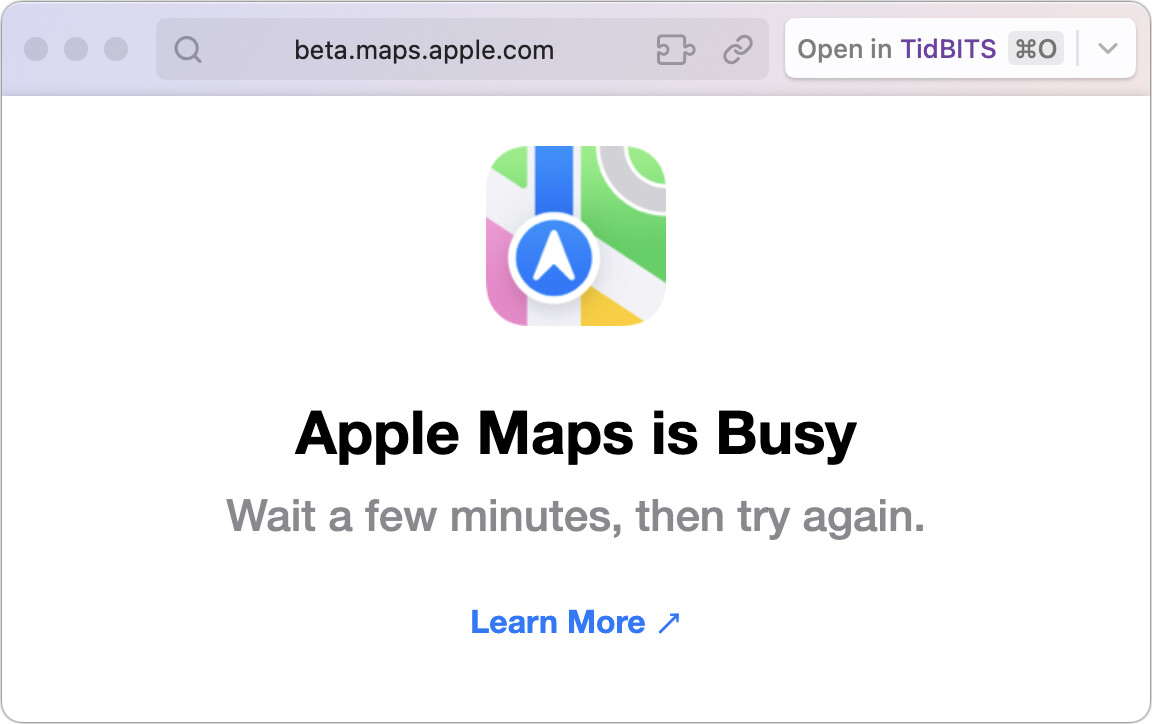
As others have said, this is a style guide issue. Apple has a style guide, which takes its overall cues from the Chicago Manual of Style (as do we). Chicago would prefer title case for titles, which boils down to the following, which would capitalize “is” because it’s a verb:
Capitalize the first and last words in titles and subtitles (but see rule 7), and capitalize all other major words (nouns, pronouns, verbs, adjectives, adverbs, and some conjunctions—but see rule 4).
However, Apple also has its own explicit rules surrounding capitalization too. They’re very clear about how “is” should always be capitalized in a title, too.
capitalization Two styles of capitalization are commonly used at Apple:
- Sentence-style capitalization: This line provides an example of sentence-style capitalization.
- Title-style capitalization: This Line Provides an Example of Title-Style Capitalization.
…
When using title-style capitalization, capitalize:
- The first and last word, regardless of the part of speech
- Nouns, pronouns, verbs, adjectives, and adverbs—no matter their length (for example, It, This, You, Your, My, Is, Are, and Be)—unless noted as an exception below
Skip This Backup
Apple News Is Offline
Passwords Are Locked
It’s not clear whether Apple would consider “Apple Maps is Busy” a title or not. I’d lean toward it being one because it doesn’t have a period at the end, like the line below it. Regardless, it’s wrong to lowercase “is” if it’s supposed to use title capitalization, and it’s wrong to uppercase “Busy” if it’s supposed to be sentence capitalization. Either one could be correct, but what’s shown is just plain wrong.
The “lowercase short words” approach that some were taught in school was probably because many students don’t have a strong grasp of the parts of speech, so saying that verbs should be capitalized but coordinating conjunctions should not be would probably be too complex. What works for freshman English doesn’t necessarily match up with professional publishing.
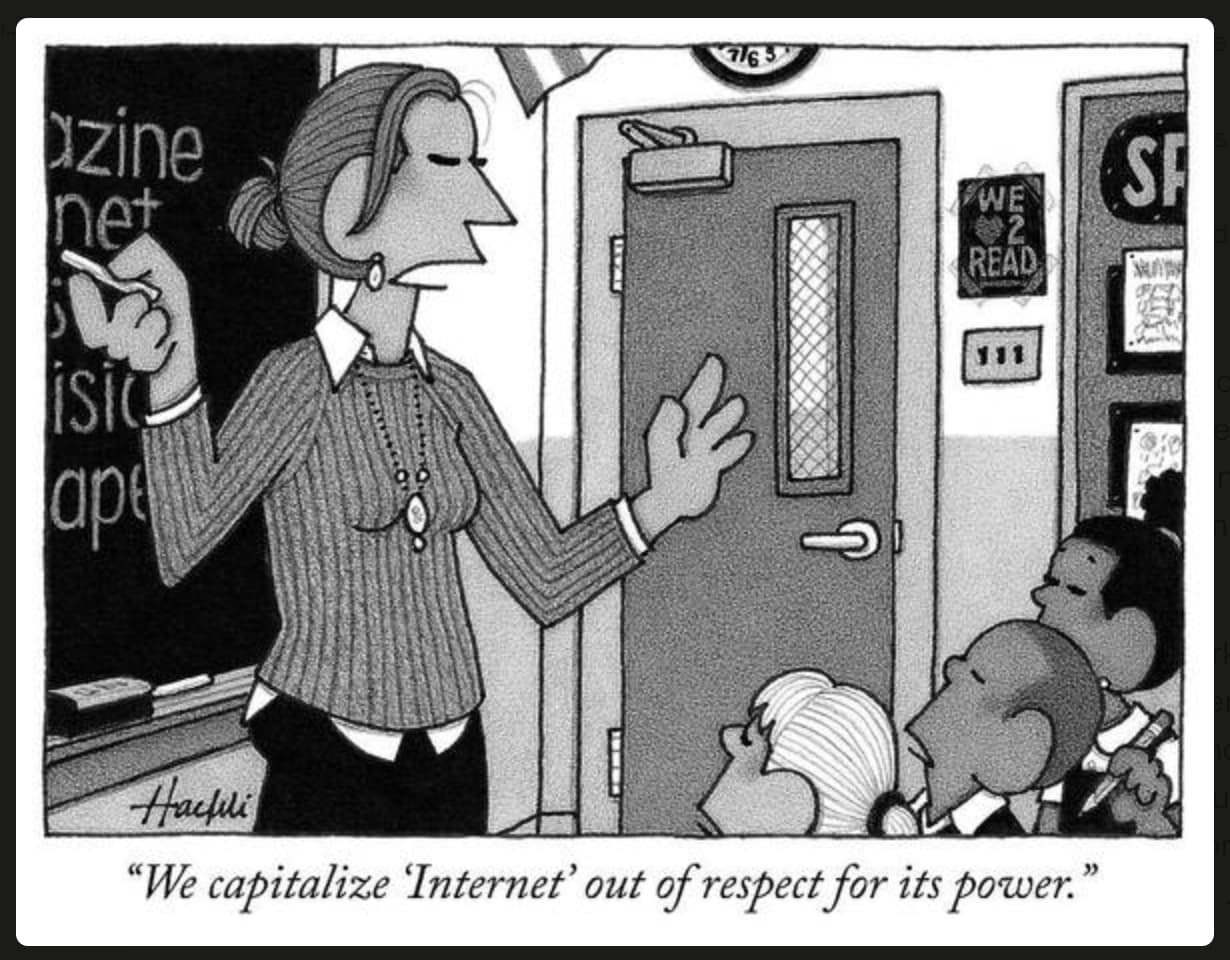
As an aside, though @frans only touched on it, TidBITS style is to capitalize Web as a noun because it’s short for World Wide Web, and that’s how Tim Berners-Lee and the World Wide Web Consortium (W3C) do it, although the W3C has moved more toward lowercase since I last looked. We still capitalize Web when used as a standalone adjective, as in “Web page,” but we lowercase it when it’s combined with another word, like “website.”
We also still capitalize Internet, and I have a copy of this print on the wall.
2 Likes
A view from across the water: in Britain, titles usually have no capitals except the first letter and any proper nouns (such as Apple Maps).
I’m not surprised—I imagine that style guides vary quite a bit by country. I glanced at the BBC and Guardian and Oxford University style guides and while I couldn’t quickly find rules on title capitalization (sorry, capitalisation), I did see some general comments about trying to avoid capital letters when possible.
It’s been possible to use Apple Maps on the web for some time by way of sites that use “MapKit JS”.
So far as I know, their biggest outside customer was DuckDuckGo, which presents Apple Maps as their mapping option in the sidebar if you search for a location