AppBITS: Fidelia Offers Audiophiles Precise Control over Music Playback

Originally published at: AppBITS: Fidelia Offers Audiophiles Precise Control over Music Playback - TidBITS

It pains me to share this, but I’m not an audiophile. I enjoy listening to music a great deal, and I know what I like, but beyond some basic level of quality—FM radio? Low-end stereos? HomePods?—I can’t be bothered to seek out ways of making music sound better. I’m not even sure to what extent I can determine what “better” means, though I have a sneaking suspicion that it mostly equals “louder than I would normally play it, though not too loud.”

All that’s by way of explaining why I’m telling you about Audiofile Engineering’s Fidelia, a music player designed for people who care deeply about audio playback, can hear subtle differences, and are willing to invest time in crafting their ideal audio pipeline. That’s not me, but from comments I’ve seen over the years, many of you may fall into that category.

Audiofile Engineering describes Fidelia as a “high-fidelity audio player” that offers “bit-perfect playback with professional DSP, Audio Unit hosting, and headphone virtualization.” It’s not new—the first version shipped in 2011—but developer Patrick Krekelberg had worked with Audiofile Engineering for years and acquired the company in 2017. For version 2.x (currently 2.9.6), he rewrote Fidelia from scratch.

Visually, Fidelia is a welcome throwback to the heyday of skeuomorphism, referencing both the industrial design of stereo components from the late 1970s and Apple’s own aesthetic from the early 2000s. It’s a lovely bit of brushed metal, and a welcome change from macOS 26’s Liquid Glass design, which emphasizes content rather than controls. You can choose from four preset sizes, and if you want the player even larger, a Scale slider in the General settings lets you double its size—it almost fills the width of a 27-inch Studio Display. There’s also a vertical Mini Player if you prefer that orientation. Because everyone who reads TidBITS knows how to use a stereo, the only thing that might confuse you, as it did me, is the Volume knob, which responds not to circular drags but to either straight vertical or (if you toggle a setting) horizontal drags.
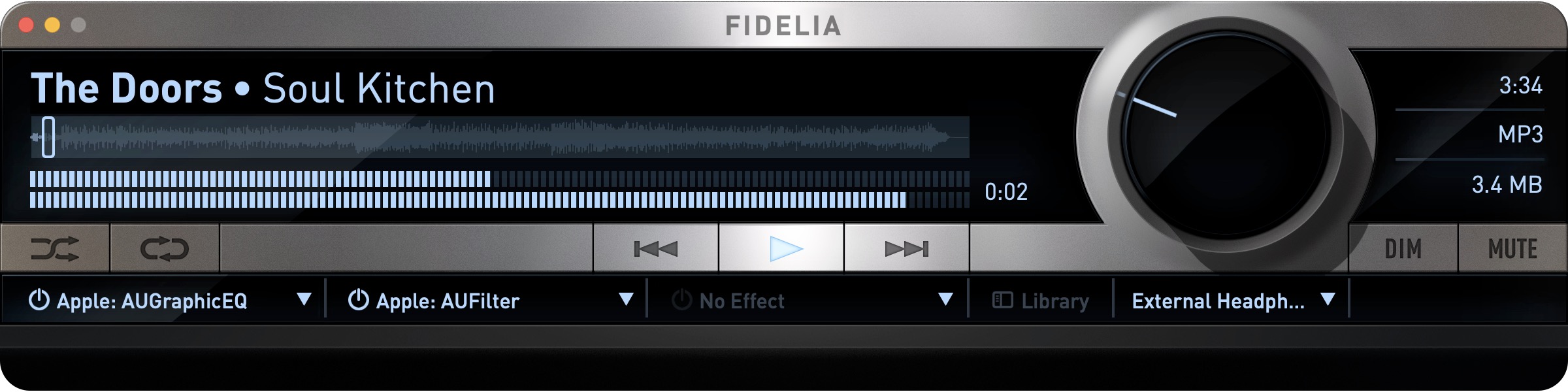
Fidelia player UI

Fidelia focuses on playing audio files from your drive, with support for numerous formats ranging from MP3 and AAC to FLAC and ALAC, plus standards like AIFF and WAV. Although it doesn’t support any online music services like Apple Music or Spotify, it can play Internet radio stations. Happily, if you’ve stored your music collection in the macOS Music app, Fidelia can access those tracks directly. It uses a standard list view by default, but there’s also an attractive album-centric view if you prefer.
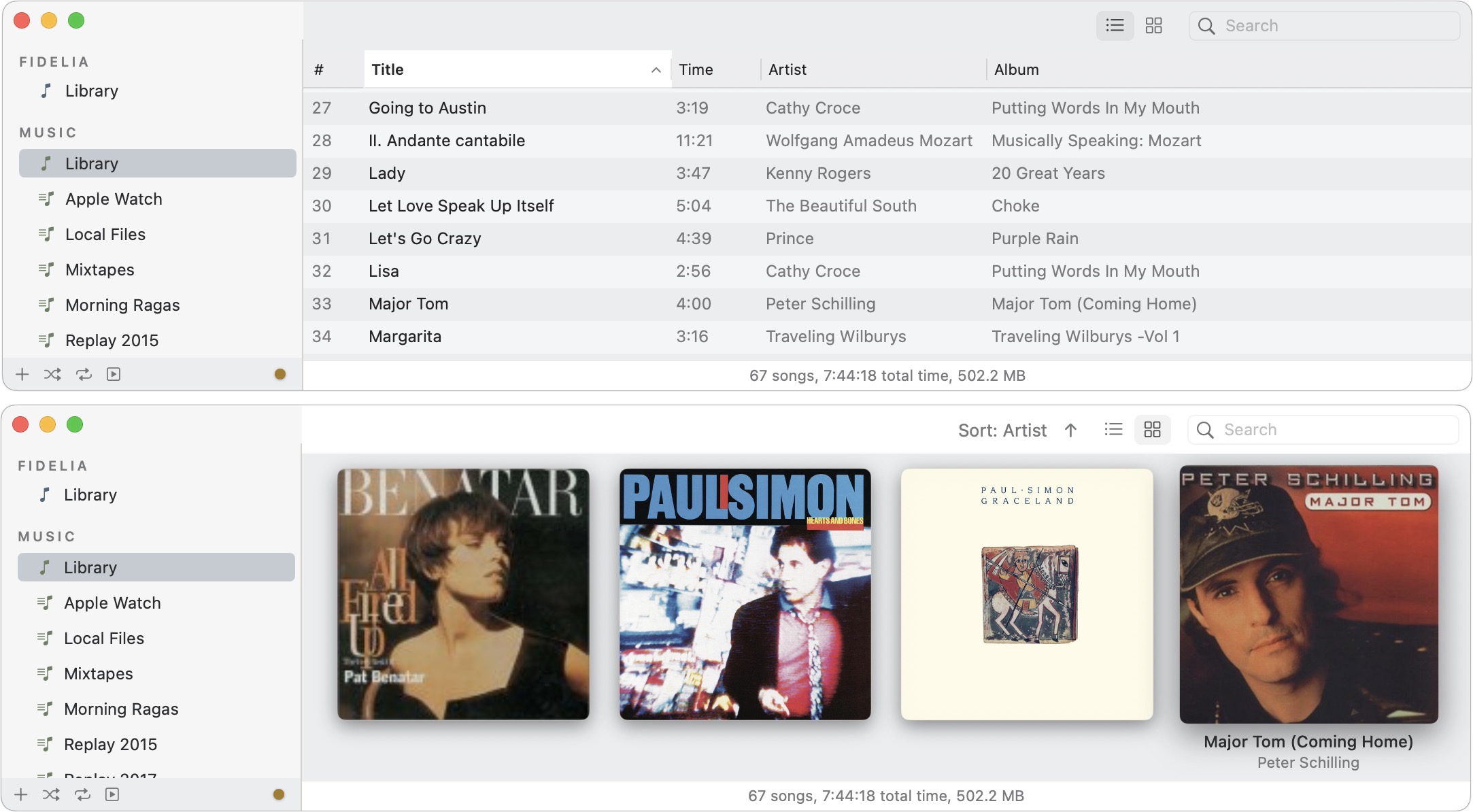
Fidelia library views

Patrick Krekelberg tells me he’s working on some design-related features that may expand Fidelia’s audience to non-audiophiles for whom the visual interface is paramount, notably a color-coded album wall.
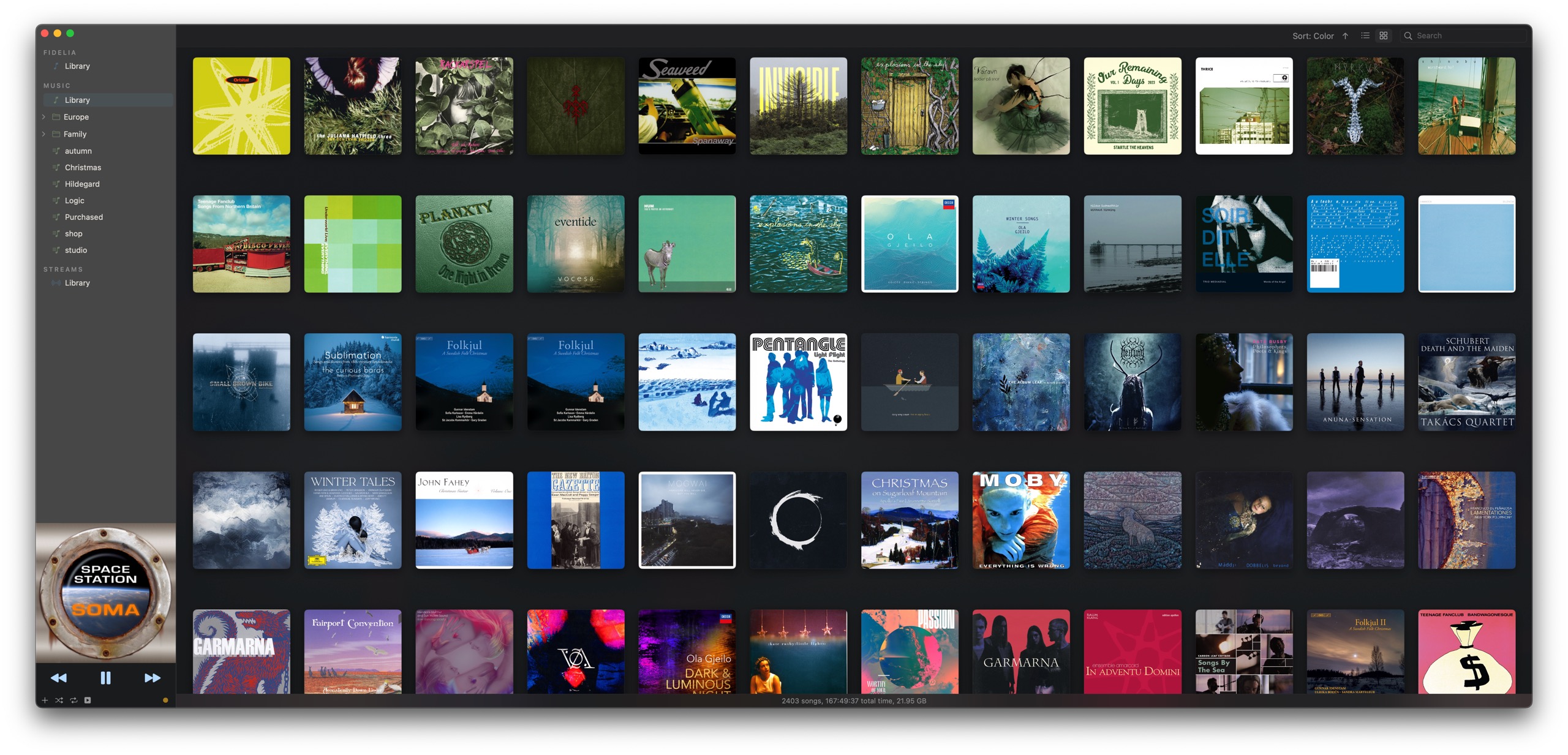
Fidelia album wall

People who want to tweak every aspect of their audio will find numerous options in several Settings panes. I’ll freely admit to having no idea what Output options like “Play DSD bit-perfect (DoP)” mean, but it’s not available on my MacBook Pro anyway. Headphone users will likely appreciate the HeadSpace options, which enable you to simulate the spatial characteristics of physical speakers. They let you configure speaker angle, channel bleed, reflection, and per-band crossfeed, among much else. Fidelia is built on top of the Audiofile Engine, and you can configure numerous settings there too, including sample rate conversion, filter steepness, and dithering type.
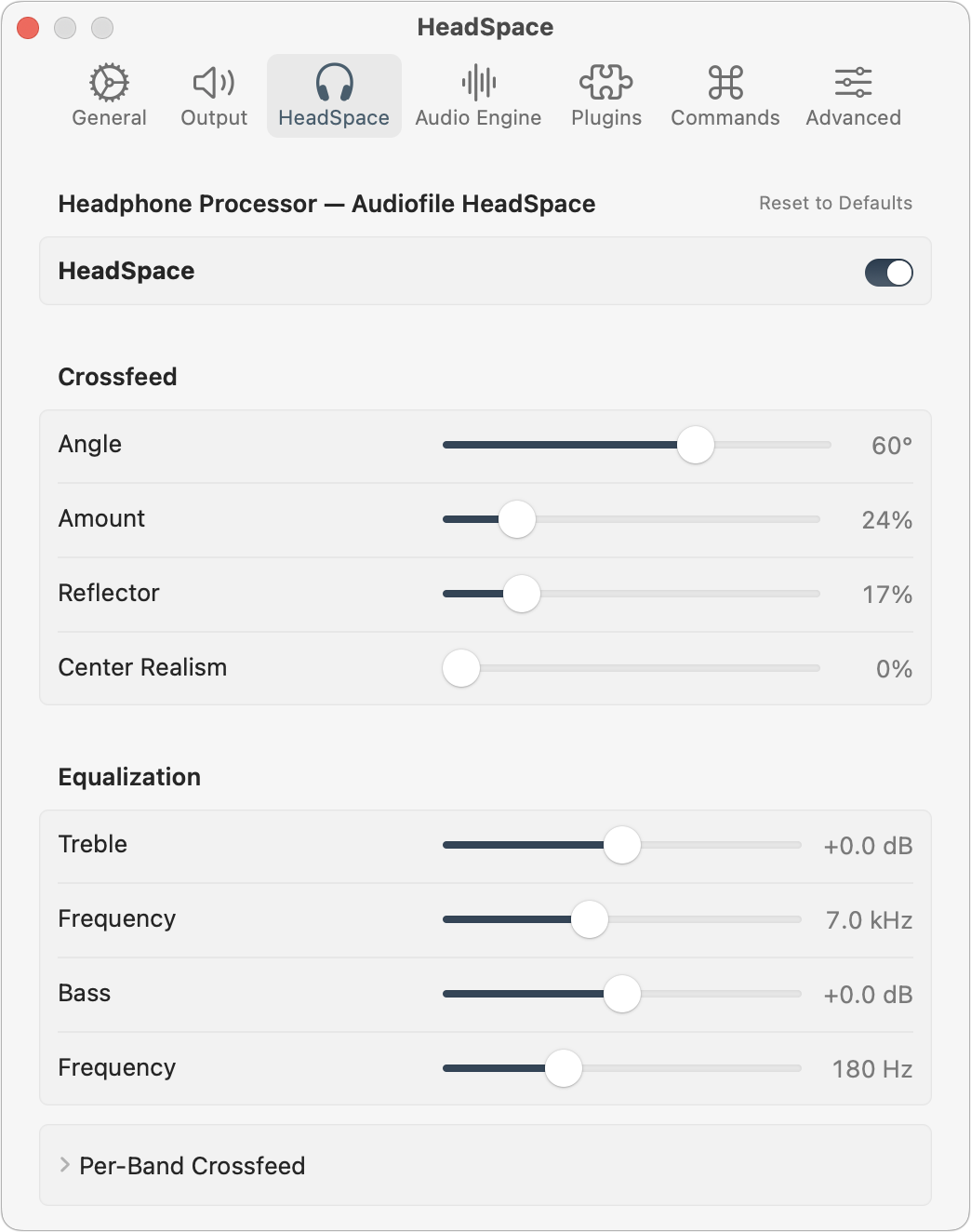
Fidelia HeadSpace settings

But the most control comes from the Audio Unit effects you can apply to audio output. You can apply up to three effects at once; I chose AUGraphicEQ and AUFilter, though I was immediately overwhelmed by the 31-band equalizer and had to switch to the 10-band version. Once you select an effect, click it to open its configuration window, where you can drag things around while listening to hear how it changes the sound. After you configure an effect, you can determine whether it’s better or worse by toggling it on and off using the On/Off button next to it in the player window.
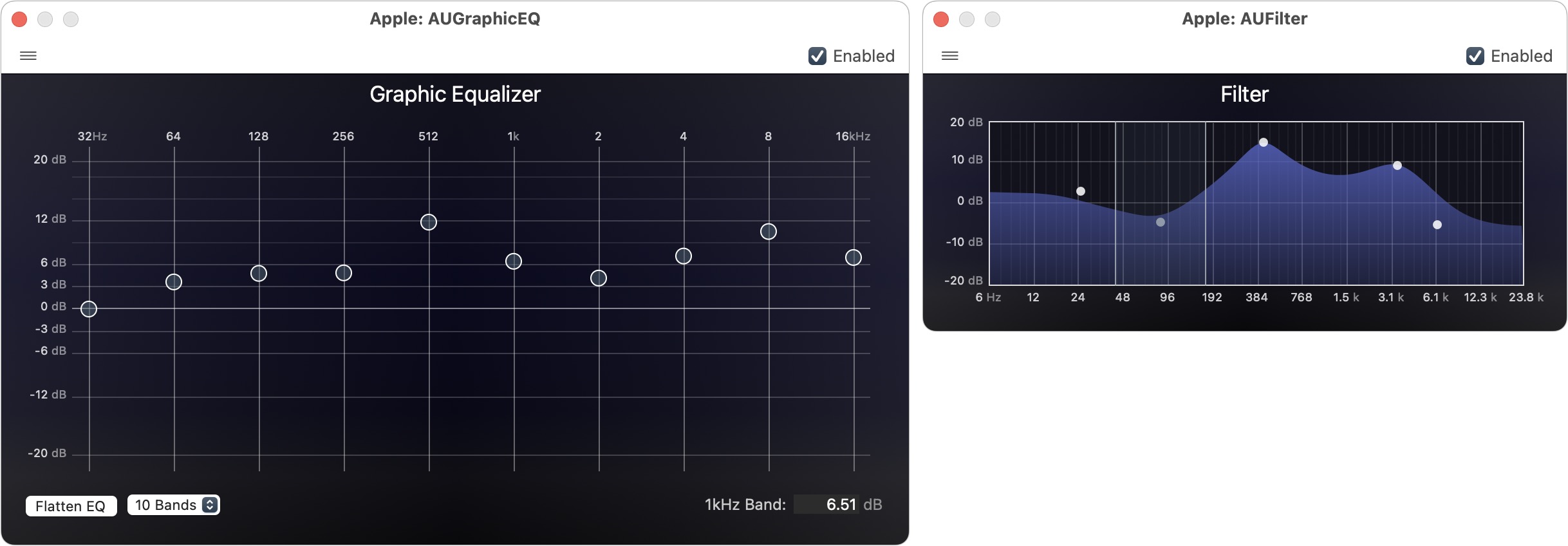
Fidelia Audio Unit effects

Overall, I enjoyed poking and prodding at Fidelia and the Audio Unit effects, and I might even have succeeded in tweaking them to make my music sound better than when played through the Music app. But again, I’m far from being an audiophile. If you are, I encourage you to give Fidelia a try. It’s available only through the Mac App Store as a 14-day trial, with a one-time introductory price of $49.99 that will rise to $69.99 soon. It requires macOS 14 Sonoma and runs on both Macs with Apple silicon and Intel-based Macs. A free Fidelia Remote app lets you control Fidelia from your iPhone.
I just took a look at this, as much as I could given that the website is broken. (Try to click on any of the “buttons” to view other features than shown.)

There are two kinds of audiophiles:

  • Those that want to listen to undistorted music. For example, audiophiles are aghast at the quality of pre-recorded cassette tapes, and are aware that lossy compression algorithms degrade the sound
  • Those that are taken in by snake-oil faith-based accessories

The problem is that there are too many products that are designed to appeal to the second group. These are the people that believe in audio cables with prices over $100,000. Unidirectional Ethernet cables. Audiophile Ethernet switches. Cryogenically treated fuses. Quantum Stickers. Wooden volume knobs. There are even audiophile power cables.

I’ll even throw in fans of vacuum tube amplifiers and record players in this category. The only reason this group likes tube amplifiers is they think that the distortion they have is appealing. And LPs have a lot of distortion.

Decades ago, before the introduction of near-perfect audio sources, you could buy equipment to fix these problems. LPs have compressed dynamic range, so you could buy a dynamic range expander to bring it back. You could adjust for other signal path problems using equalizers.

But now if you’re using headphones with CDs or losslessly encoded tracks, you shouldn’t need anything else. If you’re using speakers, it is better to use advanced room correction software built into an AVR, than try and fix it yourself with an equalizer.

So, my conclusion is that this app would have a very narrow set of cases where it is genuinely valuable. And for the rest, may I interest you in some Cable Elevators ($875) to raise your cables off the carpet? They dissipate vibrations to quiet energy transfer between the floor and the cable, which reduces noise and time smear. Obviously.

5 Likes

I wonder if the expectation is that you’d adjust the knob by spinning a mouse-wheel. But you’re right that a rotational motion, especially on a trackpad or the surface of a Magic Mouse would be more intuitive.

I think Roon is the biggest audiophile or heavy music listener system out there. It also links in your Qobuz and/or Tidal streaming subscriptions too, which I thought was excellent. The information Roon collects and offers the listener on artists/albums/tracks is phenomenal, hence people who like to read about what they’re listening to find it invaluable as an enhancement to their listening experience.

But…it does cost quite a lot for that data and playback options it offers. Though at least you know they’re unlikely to go out of business, as they actually have an income stream.

1 Like

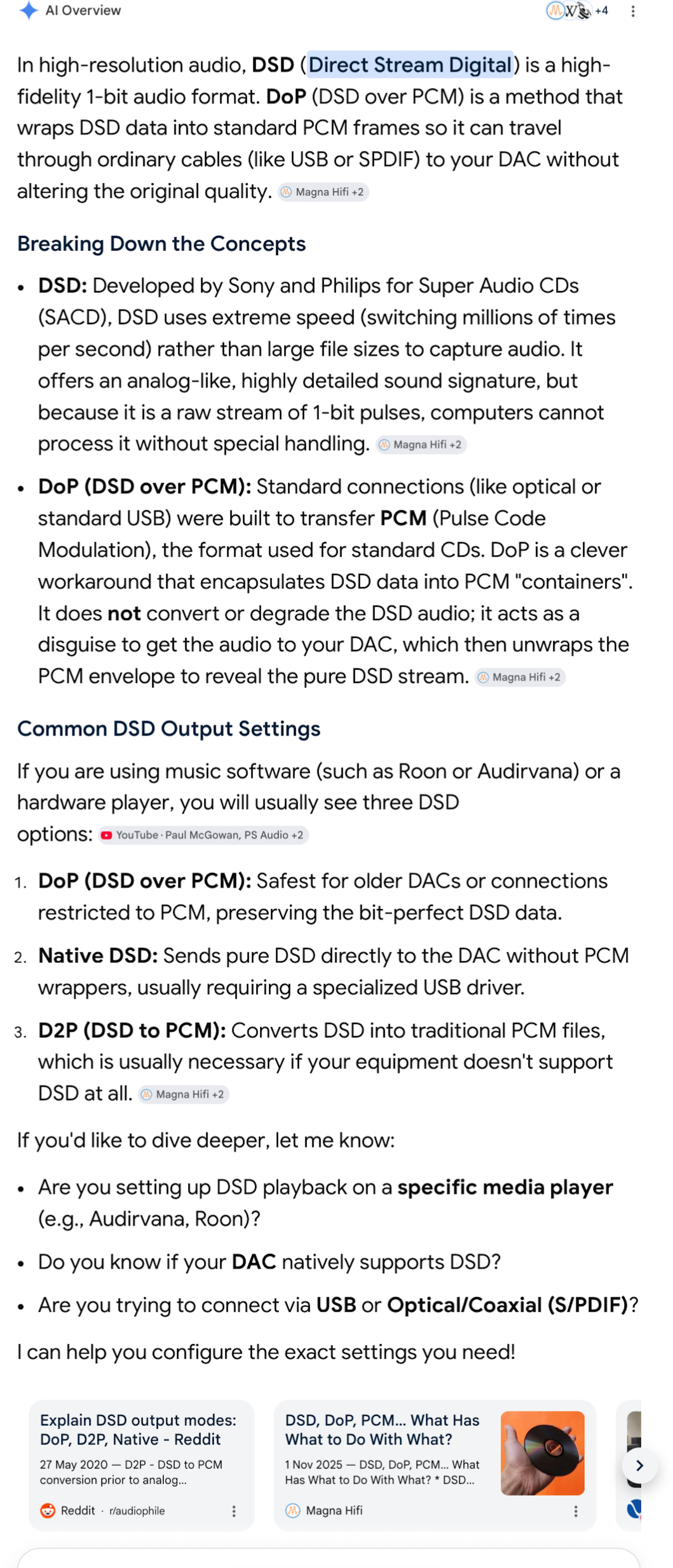
I’ll freely admit to having no idea what Output options like “Play DSD bit-perfect (DoP)” mean […]

Well, for those wondering see Gemini’s answer below to term: dsd dop meaning! :-)

You said it, simply. And, yeah, totally worthless website; gives me no confidence in the app itself, that they’d let their flagship sink so. Salesmanship, Bose-style.

I’d definitely agree with the recommendation of Roon. It integrates some streaming services (though not Apple Music which is more Apple’s choice) and offers listening across multiple rooms as well as in your car via CarPlay (using Roon ARC).

I did use Fidelia in the past and it was a good solution if you only want to listen to music when sitting at your Mac. But these days I look for more flexibility in where I can hear my music.

2 Likes

Thanks for the link to the website Michael - not sure what issues you were having but the website works perfectly for me using Safari and has lots of detailed info - will probably make use of the free 14 day trial and seems quite suited to my uses (playback of hi-res locally stored files rather than streaming).

There is also Pine Player/Pine Player Pro (app store).

Hi Michael, thanks for your feedback. Fidelia has been around for quite some time and has a hard-earned reputation for signal clarity, no salesmanship here. I am an electrical engineer and holder of several patents who loves music; we’ve been producing products for the audio industry for many years. If you’d like a technical, empirical outline of what makes Fidelia special, I’d be happy to articulate it for you.

2 Likes

Hi David, folks who have tried Fidelia over its 15 years are quite happy with it. You are welcome to try it for 2 weeks and share your thoughts. I’ve personally invested deeply in it, both figuratively and literally, so I can give you the technical ins and outs of what makes it special if you like. Our headphone processor alone (HeadSpace) was created over several years, tuned on real head acoustics. I am an engineer and musician, not a salesman. Cheers.

I think you will find Fidelia stands up quite well against Roon. We’ve been around for 22 years, which in fact is twice as long as them. Give it a try and tell us what you think. Cheers.

1 Like