Probably the oldest publications I have are a stack of MacWeek issues from the late ‘80s that may still be stashed in my closet somewhere. IIRC it was a subscription that was included with our Mac/Linotronic system at work.
If the majority of instructions are, but there are a few exceptions, then I’d still be willing to call it RISC, even if the term isn’t 100% applicable. But that’s a discussion for the academics to thrash out among themselves.
I don’t know if any commercially shipping RISC processor complied 100% with the definition, because ultimately, the goal is to provide efficient computing, not a research project.
It is still in stark contrast to processors like x86 and old mainframe instruction sets, where instructions could be many different lengths, and might require hundreds of cycles to complete (e.g. string operations).
It’s also noteworthy that these old CISC architectures today are implemented by translating those large instructions into sequences of internal instructions which are based on RISC principles, in order to gain much of the efficiency without breaking existing software.
Until I had a declutter session earlier this year my oldest computer book was an IBM (?) APL language manual from around 1978. At the time I was writing a program to analyse a census of 90,000 trucks registered in New South Wales to determine the potential effects of changes to weight limits. Not sure why I kept the book so long.
Oldest unused book. In 1980 I bought a machine code book to help me program a Sinclair zx81. Soon after I bought a Sinclair Spectrum and still have its manual (and the Spectrum but I am not sure how to adapt its analogue TV output to see if it still works).
Oldest book still in use. I still have most manuals for the SPI Open Access suite for DOS from 1985. I still use some of the apps that I wrote (using DOSbox running in Sequoia) and occasionally look up the programming manual to tweak things.
Oldest Mac book. Stored somewhere in a crate in the cellar I might still have a manual for Mac OSX from around 2003.
First computer book? Probably the stack that came with my Apple ][e… probably five pounds of manuals for the green screen, the duo-disk, the mouse and the keyboard, along with the computer itself. I have some of the magazines our local Apple User Group (“The Apple Review, communications from Apple*Van”) produced in the mid to late 80’s, and a big box of MouseTracks, the Portland Apple Users Group publication, as well. It seems nobody wants them, but they’re hard to discard! In the commercial realm, how about Bruce Presley’s 1982 “A Guide to Programming in Apple Soft” it’s the first edition, but somehow I still hav the third edition too.
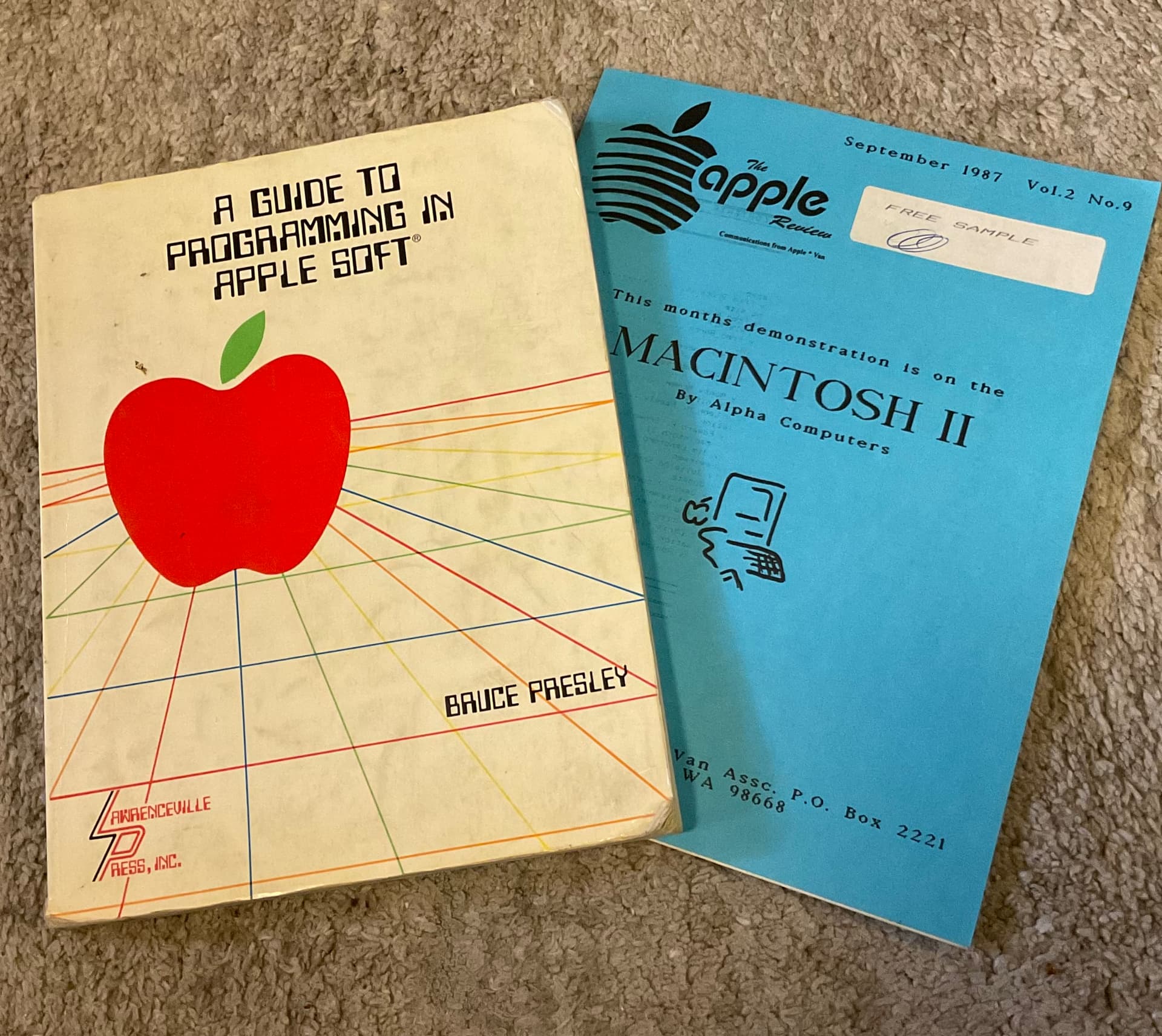
2 Likes
Oh, gosh, now — this thread brings back memories!
First book ever would’ve been 1978’s BASIC with style: Programming proverbs, by Paul A. Nagin. Loved that book.
First Apple book would’ve been Apple’s original Integer BASIC that came with my 1980 Apple ][. (The omission of any plusses or further suffixes is intentional!)
First Mac book I think must’ve been the first volume of Human Interface Guidelines, in about 1990.
But I religiously bought every issue of Byte from early ’78 until I started work at Honeywell in fall of ’82.
I read Multix, PDP-8, PDP-11, and VMS manuals aplenty, but I never actually owned them.
I still own Bruce Webster’s original The NeXT Book from 1989….
Oldest physical computer book I consult? I guess I don’t anymore. But the last one would’ve been the full Unicode standard book (all the codepoints!), of whatever edition was being sold in 1990 — I still was referring to that from time-to-time only a few years ago.
Not a book, but the publications from which I learned the most about computing were the newsletters from Richard Nelson’s HP-65 Users Club. And during my Apple II years I collected the monthly issues (Open-Apple?) published by Tom Weishaar of Resource Central. One needed to do a lot of reading to get the most out of the Apple IIgs! I had several notebooks filled with these newsletters. Alas, all gone now.
I’m not sure whether or not it classifies as a tech book but I still have the style manual, The Mac is not a Typewriter, by Robin Williams, 1990.
3 Likes
First computer book was the PDP-8 documentation from DEC. It was a very simple minicomputer with 4K of RAM. You flipped front panel switches to 1s and 0s and then hit a Load switch. Repeat that for a couple of dozen instructions then hit Run. That got it so you could read a punched paper tape and load an operating system and enable the keyboard and paper output (basically an old teletype). Then load another paper tape and eventually get to a BASIC interpreter.
Oldest Macintosh book was “Inside Macintosh”, the Phonebook edition.
The oldest computer book I still own is Software Tools by Kernighan and Plauger (1976).
I don’t refer to any of my books any more because: I’m retired as of this year at age 70, and the internet has everything I’ve needed for quite a while now.
1 Like
The oldest computer book I have — and I’m sure the first I ever had: FORTRAN IV Programming for Engineers and Scientists, by Murrill & Smith. I have not opened it in decades, and should have thrown it out years ago. It was the text for the freshman programming class I took in 1971.
1 Like
I’m happy to see so many fellow PDP-11 and VAX people in this group. We programmed them to do automation for chemical plants and refineries. First with the PDP-11s in the early 80s and then Vaxen years later.
The oldest books I still have are the MacWrite, MacDraw and Mac manuals that came with the original Mac (1984 or so) I also have a set of Inside Macintosh manuals from the mid 80s.
The oldest book I recall is this book on programming with PL/C. It was for a course I took in 74 or 75. Vivid (negative) memories of many an all-nighter in the punch card room trying to get projects finished.
The only positive memory was the all night food truck from Johnny’s Big Red
1 Like
That name brings back memories. His was the author of Beagle Bros’ “ProntoDOS” product. This product was 100% compatible with Apple’s DOS 3.3, and loaded software much faster. A must-have product at the time.
I loved getting their catalogs, since they included all kinds of fun short programs to type in, alongside the catalog listings.
2 Likes
Computer Programming Fundamentals
Herbert D. Leeds, Gerald M. Weinberg
Published by McGraw-Hill, New York, 1961
For a University of Washington assembly language programming class on the IBM 709.
I then became a student operator on the UW Research Computer Lab IBM 709 during the late shift. Early in the quarter, there wasn’t much activitiy, so when you got your chores done, the computer was yours. The IBM 709 (vacuum tube main frame) was my first personal computer.
1 Like
k&r c programming language, second edition 1988
zero mac books
some tomes about computer music
1 Like
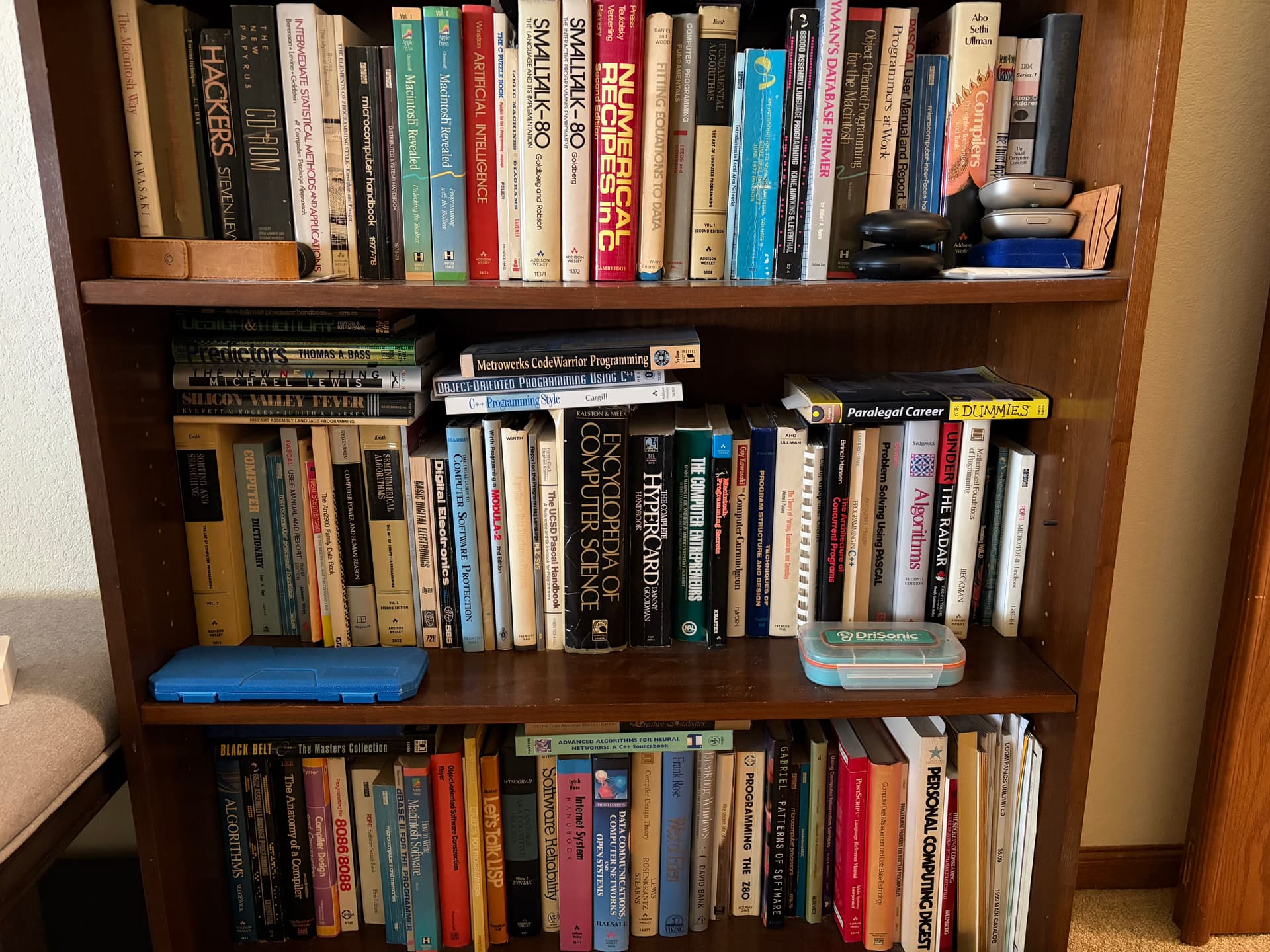
The oldest of these is probably one of the DEC mid-1970s handbooks; my first personal computer was an OEM system based on a DEC LSI-11 CPU. I probably had some older books; my first coding experience, which changed my life, was as a student in a mid-1960s CS course titled “Introduction to Algorithmic Processes’“ taught by Niklaus Wirth.
The first Mac book I used was Apple’s “Inside Macintosh”.
Related question: what is the best tech book you have?
I have a number of books on computer history and security, including:
- Hackers, Steven Levy
- The New Hacker’s Dictionary, Eric S. Raymond
- Silicon Snake Oil, Clifford Stoll
- PC Roadkill, Michael Nyman
- Insanely Great, Steven Levy
- Cyberpunk, Katie Hafner and John Markoff
- The Hacker Crackdown, Bruce Sterling
- Masters of Deception, Michele Slatalla and Joshua Quittner
- Takedown, Tsutomu Shimomura with John Markoff
- At Large, David H. Freedman and Charles C. Mann
- Fire in the Valley, Steven Levy
- Computer-Related Risks, Peter G. Neumann
- The Universal Machine, Ian Watson
- The Soul of a New Machine, Tracy Kidder
but the best of all time, no question, is The Cuckoo’s Egg, Clifford Stoll
(Fire in the Valley The Soul of a New Machine would be #2)
1 Like
My “top” books, currently:
Chasing Shadows (Deibert)
Liars and Outliers (Schneier)
The Shallows (Carr)
Culture Matters (Harrison, ed.)
Nineteen Eighty-Four (Orwell)
Bookshelf photos? I can’t resist now. Enjoy (along with the various other things on my office shelves):
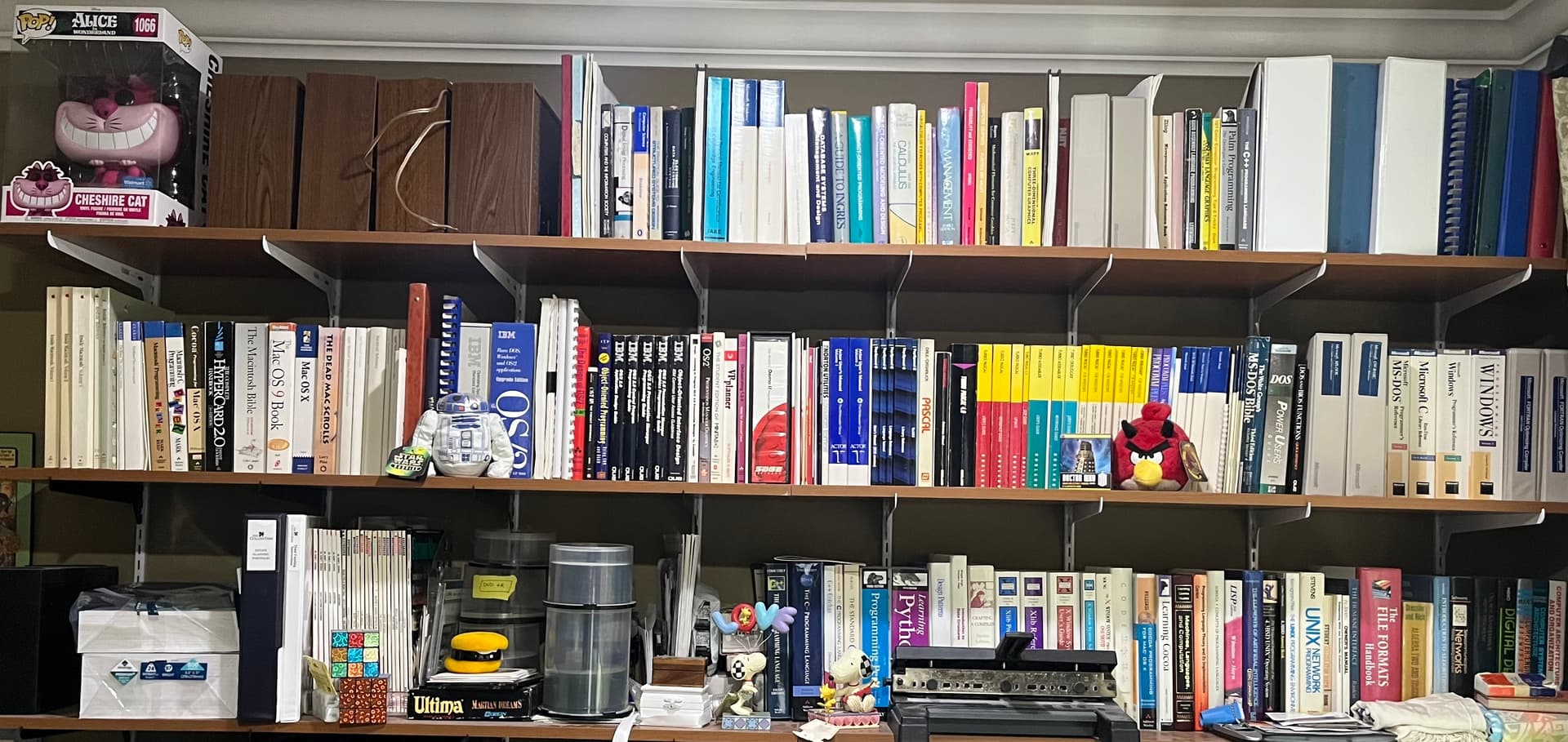
4 Likes
“Apple Presents the Apple //c”, one of several softcover books that came with my first home computer, the Apple //c! 1984 introduced me to Apple; I was already using IBM PCs running Lotus 1-2-3 and WordStar at work. Apple was a welcome change that positively affected the rest of my life.
1 Like
Macintosh revealed!? I had Vic Revealed (1982) about the 6502 chip in the Vic-20, so the user manual and Programmer’s Reference Guide would be the first manuals I had at home. I still have the CBM=64 equivalents. The 64 was Commodore’s next machine. A few years later I acquired IBM REXX manuals from working with IBM mainframes that were being superseded. Hoping to use these books again some day…
The slim manual for the Amiga, covering AmigaDos 1.3, was excellent. I always found what I wanted, where I expected to find it in the index.
The only Mac book I remember owning was The Mac Bathroom Reader.
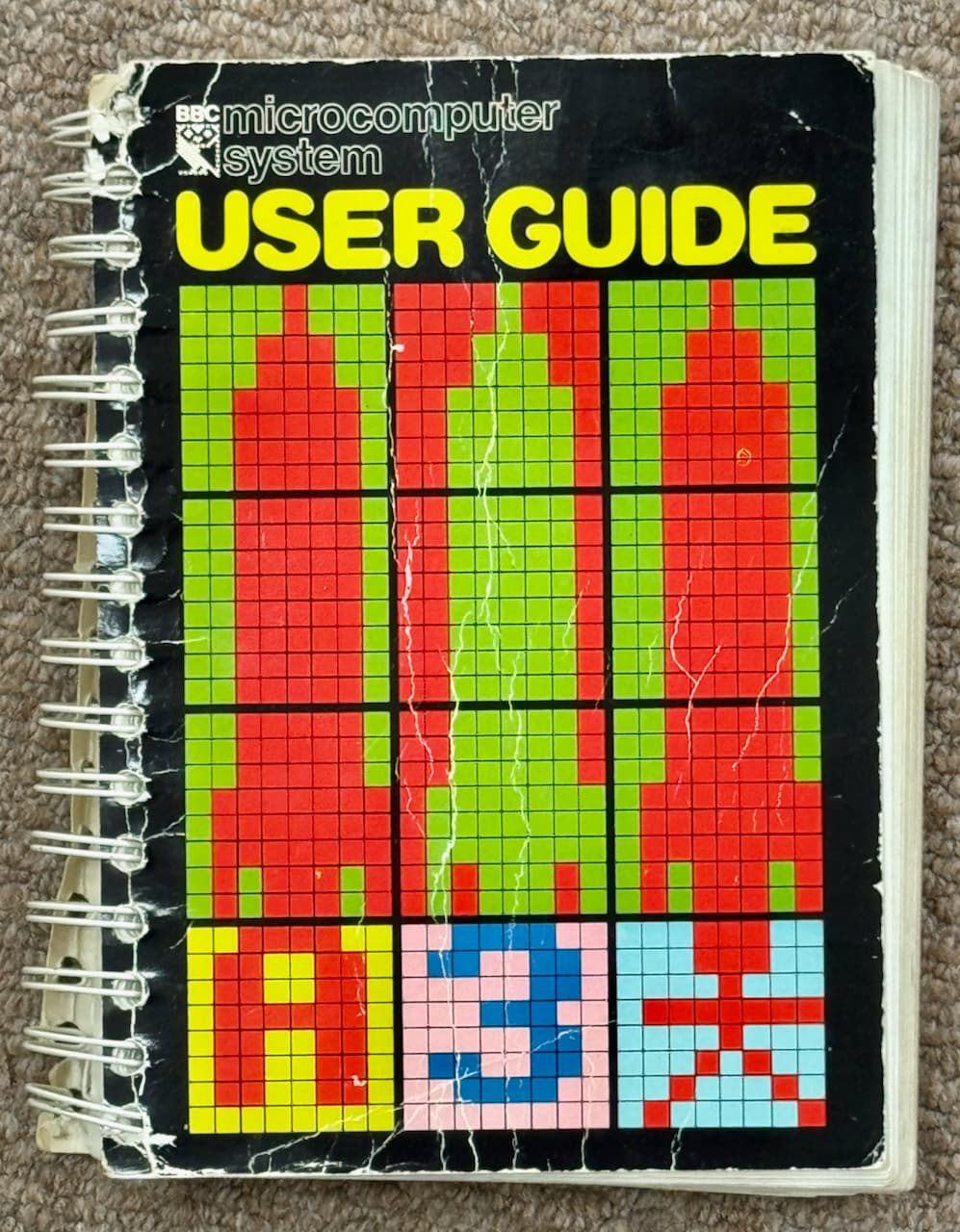
My first computer was a BBC Micro. Those who don’t live in the UK may not be very aware of it. Produced by Acorn Computers and based, I believe, on their Atom model. It was done in conjunction with the BBC, which produced a TV Programme that ran at the same time called The Computer Programme. This did much to encourage people like me (I was 22) to enter the world of home computing. I bought the bigger ‘B’ machine with 32K of RAM and it cost £399. I also had to purchase a colour monitor and a cassette machine to save the BBC BASIC programs that I had typed in. I still have the Epson FX-80 dot-matrix printer, which cost another whopping £500!
My first Mac book was the User Manual that came with my LCII. I read it from cover to cover, whilst sitting at the machine and then read it right through again. By the end of that, I reckon I was fairly proficient. The floppy disk that taught you how to use the mouse was also excellent and fun.
3 Likes