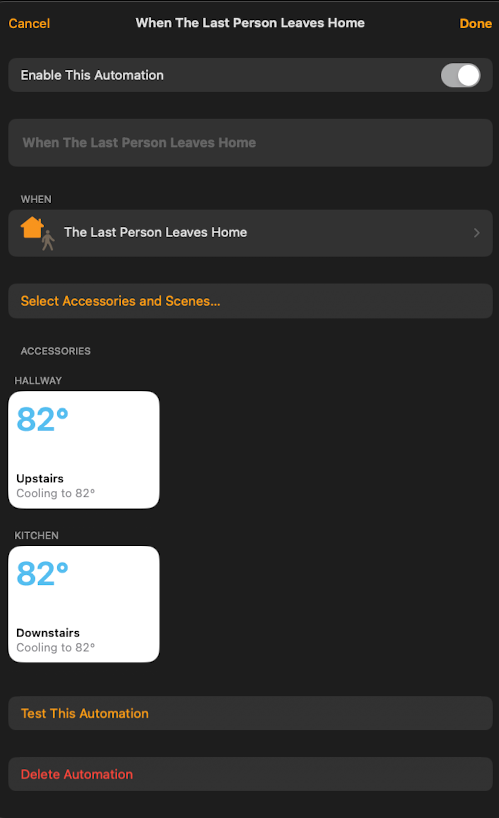
The articles I was reading indicate that the Nest Learning Thermostats will still function without access to Google’s servers; there just will be some loss of the “smart” functionality. Users will lose the Nest’s ability to learn and create new schedules on its own, and the Home/Away Assist feature will be completely non-operational. I expect that remote access via the Nest app may also be impaired or removed.
What will be left is still a good, functional programmable thermostat. Users will just have to create and adjust schedules manually. I don’t know if Internet access will still be required; I know that our Nest loses a lot of capability if the WiFi goes down, but I don’t know if that would be mitigated by a signal from the servers Google continues to operate telling the deprecated units, “I can’t do anything for you, but you can still function.”
My experience with Ecobee is mixed. Two years ago, we had to replace our entire HVAC system, and the company we bought from threw in a new smart thermostat for free, with a choice of either Ecobee or Honeywell. I’d heard better things about Ecobee than Honeywell, so we went with that.
It functioned just fine as a programmable thermostat, but it fell down strongly in the “smart” side of functionality. I don’t know if the issues were due to the specific model we got or are common to the entire line, but it had no learning capability at all—we had to manually set up every schedule. It was basically a programmable thermostat with a fancy digital display and remote app access.
What really disappointed us compared to the Nest was the Home/Away function. Nests can determine who’s home by checking the locations of phones in the household that have the app installed and registered as part of the household. This works pretty well when everyone in the household carries their phones with them everywhere, as we do.
The Ecobee, on the other hand, relies on sensors to determine if anyone’s home. One is built into the thermostat unit itself, and it comes with a single additional sensor. More sensors cost a hundred bucks for a 2-pack. Despite claims I’ve seen from Ecobee, my experience with these “SmartSensors” indicates that they rely almost entirely on motion and have little to no heat-sensing capability.
This led to an issue because of my sleep schedule. My sleep tends to be erratic, and I usually don’t go to bed until hours after midnight and then sleep until late morning. Even with the sensor in my bedroom pointed directly at my side of the bed, it didn’t register that I was home because I wasn’t moving. And with only one moveable sensor, when my spouse was working from home, we couldn’t have the sensor detecting both me in the bedroom and her in the home office, and whether either of us happened to be in those locations was variable. My own home office area is in a corner of our living room (I do most of my work after my spouse goes to bed), and the thermostat is in the dining room, meaning that it still couldn’t detect me when I was working less than 4 meters away. Because of this, we had to disable the Home/Away functions and remember to manually adjust it when we left and returned. That should be unnecessary with a smart thermostat.
So I won’t return to Ecobee unless they change the Home/Away function to be able to work from information that’s more reliable and ubiquitous than $50 SmartSensors, or Google kills our third-generation Nest and we can’t find a non-Google device with the same functionality that we’ve become accustomed to with the Nest.