I have an Ultra 1 and and Watch 6 which I got during the pandemic. I’m monitor blood oxygen on a daily basis. I’ve compared to a finger pulsiometer and find the results to track closely. I disagree about the usefulness of it on the watch. This upgrade makes my getting an Ultra 3 more likely.
My theory is that the measurement device requires direct, hard contact with the skin to function correctly. If the wrist moves at all, contact will be lost, and no reading will occur. Fingertip oximeters use spring tension to keep contact. I’ve also done a sleep apnea test where the oximeter surrounds the finger, and an air bladder is used to secure the finger.
I think if you attached the watch tightly enough to hurt, you’d get a reading every time.
Now if we could only get a decent continuous glucose monitor (CGM) on an Apple Watch. My current CGM button has a ¼" needle on it, so CGM on a watch would require some sort of new and novel skin sensor (??) since my watch moves around a bit on my wrist and visits a charger at least once per day.
Curious. I’ve been ignoring 11.6.1 and haven’t been alerted yet. It’s not worth stressing over little things like this.
The customs ruling has been released.
https://rulings.cbp.gov/ruling/H351038
I’m not a lawyer, but my quick read of this is that Apple successfully argued that watches imported into the US could not calculate blood oxygen levels on their own (without the companion iPhone), so the watch was no longer infringing on the specific wording of the Masimo patent(s) in question. Personally I’m not sure I’m persuaded that this is relevant, but, again, im not qualified really to evaluate the ruling.
I would say that it would depend on the specific nature of the patent.
If the patent is on the basic tech of measuring blood oxygen through light-reflection (vs. transmission, the way most pulse-ox meters do), then I don’t think Apple’s change affects anything.
But if the patent is on the application of the tech to a wrist-mounted monitoring device, well that’s different.
IANAL either, but this seems to suggest the issue isn’t with the actual hardware in the unaltered watches, but with the software system that processes it, which always seems to be an area of patent law that looks questionable to someone like me.
In any case, I’m glad to have the feature back, even if it is a bit less convenient having to look on the iPhone to get the result rather than on the watch itself.
My understanding is the relevant patent expires in 2027, and I’m going to guess the Blood Oxygen app reappears fully functional on the Apple watches as a x.1 update as soon as it does.
I’d be interested to learn if the hardware itself is changed in the new watches that are supposed to be released this fall, though my guess is Apple
Kevin
I’m yet another non-lawyer commenting, but I think this is more a jurisdictional issue - the ruling comes from the International Trade Commision. They are not actually ruling on the validity of the patent, just on how the infringement of an assumedly valid patent affects Masimo’s international trade - and since they do not make phones, there is no “unfair trade” when importing a phone that violates the patent.
A ruling on the validity of the patent itself would need to come from a different court.
So, processing the collected data on the phone rather than the watch does not violate the patent. Couldn’t Apple take it a step further so that after processing the data, the iPhone sends the results back to the Apple Watch so that they can be seen there? The only time there would be a significant delay would be if the phone were not currently able to communicate with the watch, so that the results would not appear until the data were transferred to the phone.
From the ruling:
Second, Apple argued that “even if the preamble was not limiting, the Redesign 2 Watch does not satisfy the other limitations of claim 22 because the Watch itself cannot output ‘measurements’ responsive to the recorded PPG signals, and the individual PPG signals themselves are not ‘indicative of’ oxygen saturation.”
So Apple is saying because the watch is not showing output, it’s not infringing, suggesting that if it was showing output then Apple could not make that argument.
2 Likes
So one amusing (to me at least) outcome of this thread is that it made me look at my Series 8 watch to see if it had the Blood Oxygen app, which I had never used. So I did, and it does. But my measurement is “100%”. So either it’s not very accurate, or I’m in such good health that it doesn’t matter. 
The inimitable D C Rainmaker noted the reintroduction of SpO2 on Apple Watch in his short article Apple Watch US Users (Re)Gain Blood Oxygen Feature. I believe, after reading several of his in-depth reviews on SpO2 monitoring on the Apple and other devices, that he is sceptical about the usability of this monitoring, for athletes at least.
I see there is a 2019 Mayo clinic paper concluding that “Although smartwatches are able to provide SpO2 readings, their overall accuracy may not be sufficient to replace the standard photoplethysmography technology in detecting hypoxia in patients with COVID-19.” Is hypoxia the main issue patients (rather than athletes) are looking to detect, and has tech improved much since then, I wonder?
Yeah, as I was wondering over multiple threads — does Masimo agree with this? The answer is no:
1 Like
This doesn’t surprise me. If you are checking for an actual condition, using a more traditional monitor (e.g. a clip on your finger) should definitely be used.
But a monitor that is continuously taking measurements (e.g. a watch) that can alert you to something unusual is also of benefit even if the alert is only accurate enough to ask you to take a reading with a better device.
1 Like
I’m interested to know if this is the case. If false positives or false negatives occur more than – say – 10% of the time, is a watch useful for this important data?
I guess this is similar to the fact that most sports watches struggle to get good heart rate readings because wrists are just a terrible place to read that information. My Polar H1 monitor, which I put on my upper arm, provides comparatively rock solid readings.
The watch format is fun but using the case as a sensor station doesn’t suit all cases, and I wonder if SpO2 is one of those.
1 Like
I’d say that if you’re wearing a smart watch for the purpose of measuring health data like SpO2 levels, then you’re making a mistake and should instead use a device meant for that purpose.
But, if you’re wearing a smart watch anyway (e.g. because you like taking phone calls on your wrist or running its apps, etc.) and the health monitoring is something you get for free, then I don’t see a problem. Just like the other things it monitors in the background, like fall detection and AFIB detection. If it alerts you, then you can follow up by consulting with your doctor.
If it fails to alert you (false negative), then it’s no worse than if you weren’t wearing it. And if it alerts you too often (false positive), I assume you’ll be able to turn it off. As long as you don’t assume that a lack of alerts is the same as a diagnosed clean bill of health, then what’s the problem? (Of course, some people will do that, but people believe all kinds of unreasonable things.)
1 Like
As somebody who has had blood oxygen background readings for almost three years, since buying the Ultra, and as somebody who is very healthy and doesn’t really need to monitor blood oxygen levels, I wouldn’t miss it if it doesn’t ship with the (presumed) Ultra 3 this autumn when I am ready to upgrade. It seems mostly accurate, with occasionally laughable readings in the 80s, but otherwise readings in the 95-100 range for me. At any doctor’s office visits I am always 99-ish. But I’d welcome it if I had a health condition where monitoring blood oxygen would be helpful, so it would be nice if Apple shipped it. It would be nicer if they hadn’t blatantly used someone else’s patented technology without a license and with the full knowledge that the patents existed.
The heart rate sensor itself has been great since I’ve owned an Apple Watch, since early 2017.
My graph for the last year:
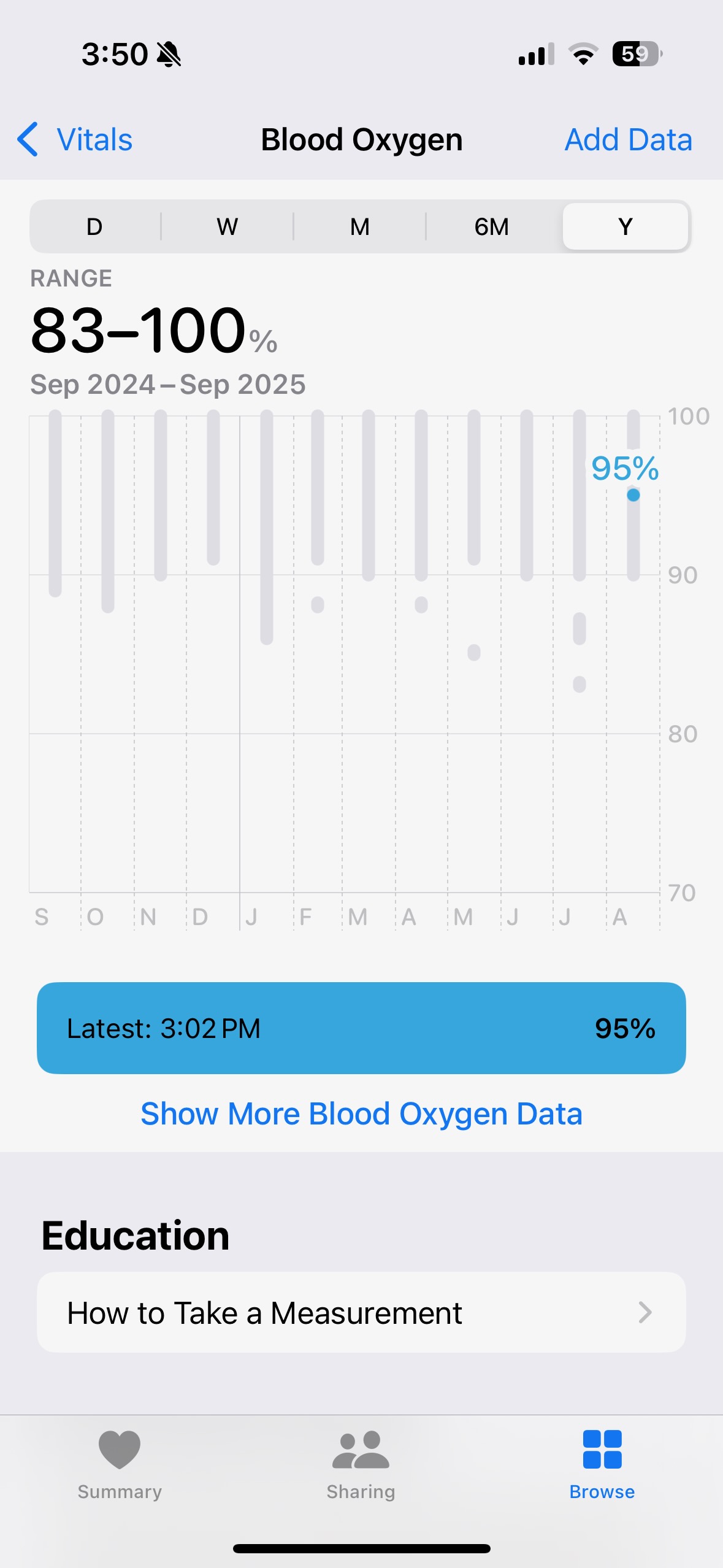
Really any reading under 95 is probably not right. I just took a manual reading, using Apple’s suggestion for a proper reading - “Stay still, and make sure your wrist is flat with the Apple Watch facing up; Tap Start, then keep your arm steady for 15 seconds” - 100%.
That’s great. Since I’m a bit of a sceptic about the accuracy of write-based heart readings (never mind SpO2), I’d be interested to know if you verified those results with a chest strap or something similar.
I don’t know enough about Bayesian theory to know if inaccurate test results are worth having; I guess it depends on the degree of inaccuracy.
Not a chest strap - I used an upper arm strap for a short while after I first got my Apple Watch (I used it for a while before the Apple Watch), but stopped bothering when I realized that the watch was matching it.
The 3 year old cover for my iPad is falling apart. Apple can’t claim that it is a quality product, although it has a quality price.